
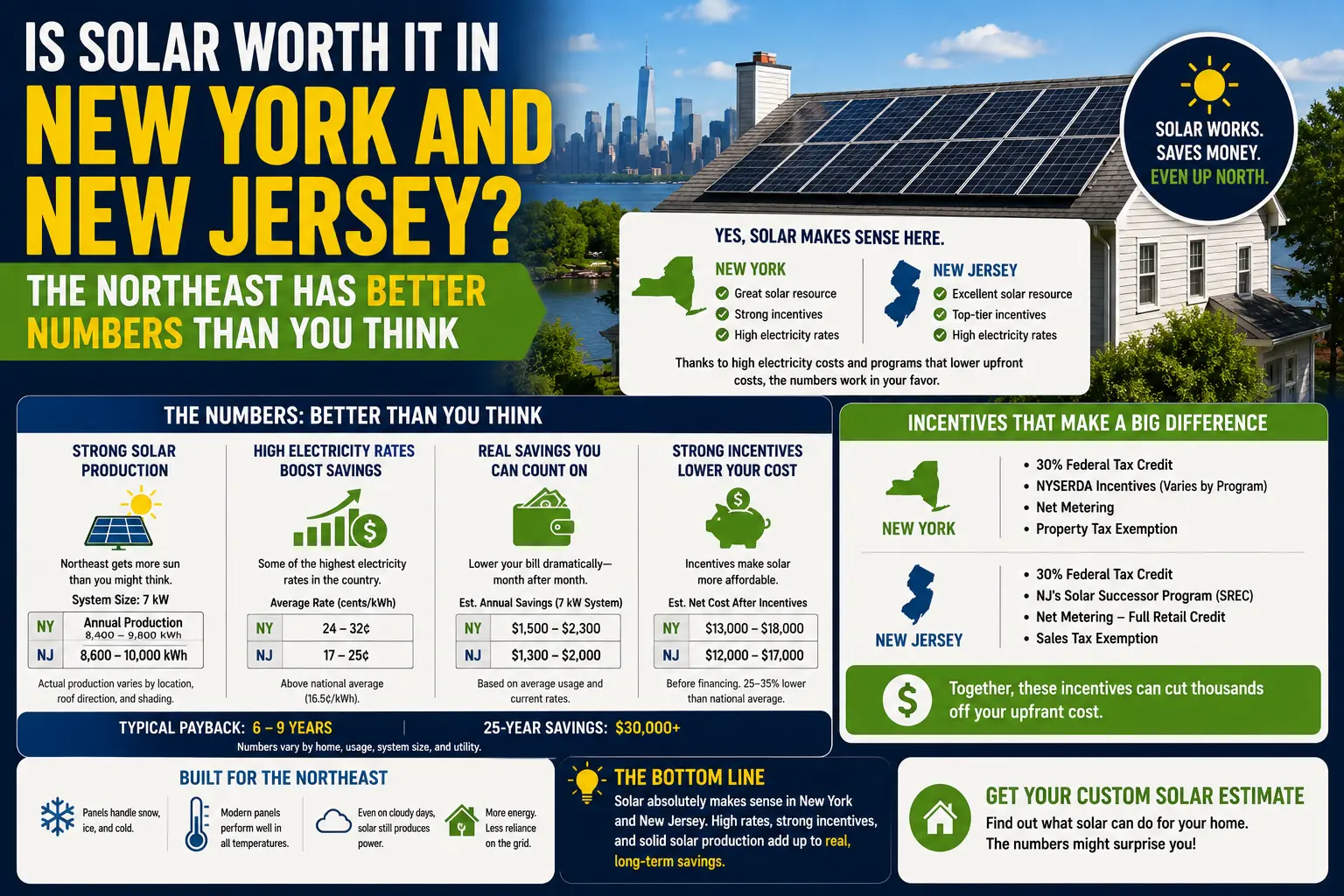

New Jersey homeowners with solar systems routinely earn $3,000+ per year in income — just from selling certificates that prove their panels generated electricity. Not from electricity savings. From certificates. On top of the electricity savings.
That number stopped me when I first researched it. I’m in Austin, paying $0.117/kWh for electricity. New Jersey homeowners pay about $0.18/kWh and have access to one of the most valuable solar incentive structures in the country. When I ran the NJ numbers out of curiosity, the payback period came out shorter than mine in Texas.
The Northeast has a reputation as a marginal solar market — not enough sun, too cold, too cloudy. That reputation is outdated and, in the case of New Jersey especially, simply wrong. Here’s what the numbers actually look like.
The Sun Hours Reality Check
Yes, New York and New Jersey get fewer peak sun hours than Texas or Arizona. New York City averages 4.0–4.2 peak sun hours per day. Northern New Jersey averages 4.1–4.3. Austin averages 4.9. Phoenix averages 5.8.
The difference is real — roughly 15–20% less solar resource than Texas, 30–35% less than Phoenix. A 9.6kW system that produces 14,300 kWh/year in Austin would produce approximately 12,000–12,500 kWh/year in northern New Jersey.
Here’s what matters more: electricity in New York costs $0.21–0.24/kWh. In New Jersey, $0.17–0.19/kWh. In Austin, $0.117/kWh. Every kWh my panels produce in Austin saves me roughly half what the same kWh would save a New York homeowner. Lower sun hours plus higher electricity rates can produce better economics than more sun plus cheaper electricity — and New Jersey adds a third variable that changes everything.
New Jersey: The SREC Program That Makes the Math Exceptional
New Jersey’s Solar Renewable Energy Certificate (SREC) program — now transitioning to the Transition Renewable Energy Certificate (TREC) system for newer installations — creates a second revenue stream for solar homeowners entirely separate from electricity savings.
Here’s how it works: for every 1,000 kWh your solar system produces, you earn one SREC (or TREC). New Jersey utilities are required by state law to source a percentage of their electricity from solar — and if they can’t generate it themselves or buy certificates from solar homeowners, they pay a penalty. That requirement creates a market for SRECs, and New Jersey’s market has historically been one of the most valuable in the country.
SREC prices in New Jersey have ranged from $150 to $300+ per certificate over the past several years. TREC prices under the newer program are set administratively — currently at approximately $152–$198 per TREC depending on project category.
The math on a 9.6kW system in northern New Jersey:
- Annual production: ~12,200 kWh
- SRECs/TRECs earned: approximately 12 per year
- At $175/certificate: $2,100/year in certificate income
- Annual electricity savings at $0.18/kWh: approximately $2,196
- Total annual solar benefit: ~$4,296/year
On a system costing $28,000 gross ($19,600 after 30% ITC), that’s a payback period of roughly 4.6 years. That’s faster than my Texas payback, with 20% fewer sun hours.
New Jersey also offers:
- Full retail net metering — exported kWh credited at full retail rate
- Property tax exemption — solar doesn’t increase your assessed value
- Sales tax exemption — solar equipment is exempt from NJ’s 6.625% sales tax ($1,855 on a $28,000 system)
The SREC/TREC program has evolved over time and the specific program available to new installations depends on when you interconnect and which NJ Clean Energy program you enroll in. Check the NJ Clean Energy Program for current rates — but the structure of certificate-based income on top of electricity savings is what makes New Jersey consistently one of the top 3 solar ROI states in the country.
New York: NY-Sun and High-Rate Economics
New York doesn’t have the SREC income stream that makes New Jersey exceptional, but it has a combination of high electricity rates, a meaningful upfront incentive, and full retail net metering that produces solid economics — particularly in the New York City metro and Long Island.
NY-Sun Megawatt Block Incentive: New York’s NYSERDA (New York State Energy Research and Development Authority) administers the NY-Sun program, which provides upfront incentives for residential solar on a declining block structure — as more solar is installed in each utility territory, the per-watt incentive steps down. Current residential incentive rates vary by utility territory but have ranged from $0.20 to $0.40 per watt for recent residential installations. On a 9.6kW system, that’s $1,920–$3,840 in direct state incentive off the system cost.
Property tax exemption: New York offers a 15-year property tax exemption for solar installations — the solar-attributable increase in your home’s assessed value is excluded from property taxes for 15 years after installation. On a system that adds $15,000–$20,000 to home value in a high-tax county like Westchester or Nassau, this is genuinely valuable.
Net metering: New York maintains full retail net metering under its Value of Distributed Energy Resources (VDER) framework, though the specifics of export compensation vary by utility and customer type. Con Edison, NYSEG, Central Hudson, and PSEG Long Island all participate in net metering programs.
The Long Island situation: Long Island electricity rates — among the highest in the continental US at $0.24–0.28/kWh through PSEG Long Island — make Long Island one of the strongest solar markets in the country on pure electricity cost savings alone, even before NY-Sun incentives.
New York City specifically: New York City limits rooftop solar opportunities because most NYC residents live in apartments and don’t control their roofs. For NYC homeowners (primarily in Staten Island, Queens, Brooklyn, and the Bronx), solar works. For renters and condo owners, community solar subscriptions are the relevant alternative — a topic worth its own exploration.
NY payback estimate (Westchester County, Con Edison territory):
- System: 9.6kW
- Annual production: ~12,000 kWh
- Electricity rate: $0.22/kWh
- Annual savings: ~$2,640
- System gross cost: $28,000
- NY-Sun incentive: ~$2,500
- Net after incentive: $25,500
- After 30% ITC: ~$17,850
- Payback: approximately 6.8 years
Good, not spectacular. But in Nassau or Suffolk County on Long Island at $0.26/kWh, the same analysis produces a 5.4-year payback — among the best in the Northeast.
How the Northeast Compares to Sun Belt States
| Austin TX | Phoenix AZ | Northern NJ | New York (Con Ed) | Long Island | |
|---|---|---|---|---|---|
| Peak sun hours/day | 4.9 | 5.8 | 4.2 | 4.1 | 4.2 |
| Electricity rate | $0.117 | $0.135 | $0.18 | $0.22 | $0.26 |
| Key state incentive | None | None | SREC/TREC | NY-Sun rebate | NY-Sun rebate |
| Net metering | Full retail | Reduced (RCP) | Full retail | Full retail | Full retail |
| Est. payback (9.6kW) | ~6 years | ~9 years | ~4.6 years | ~6.8 years | ~5.4 years |
New Jersey outperforms Texas on payback period despite having 14% fewer sun hours, primarily due to the SREC income stream. This is the same dynamic that makes California’s NEM 3.0 change so painful — policy structure matters as much as sun resource. And the 30% federal ITC applies equally in every state, so the starting point is the same regardless of geography.
Who Should Go Solar in New York and New Jersey Right Now
Strong candidates:
- New Jersey homeowners in nearly any service territory — SREC/TREC income makes the economics exceptional
- Long Island homeowners — high electricity rates make even a conservative production estimate pencil out well
- Westchester, Nassau, and Rockland County NY homeowners — high rates plus NY-Sun incentives
- Any Northeast homeowner with an owned, unshaded south or southwest facing roof
Consider carefully:
- Homes with significant shading (mature trees, neighboring buildings) — reduced production matters more when you have fewer sun hours to start with
- Older roofs in need of replacement — do the roof first
- NYC apartment residents — community solar is the relevant option, not rooftop solar
The Northeast solar narrative needs updating. “Not enough sun” was a reasonable concern when panel prices were $7/watt and state incentives were thin. At today’s prices, with New Jersey’s SREC program and New York’s combination of high rates and NY-Sun incentives, the Northeast is genuinely competitive with — and in some cases better than — Sun Belt solar markets.
— Allen
