
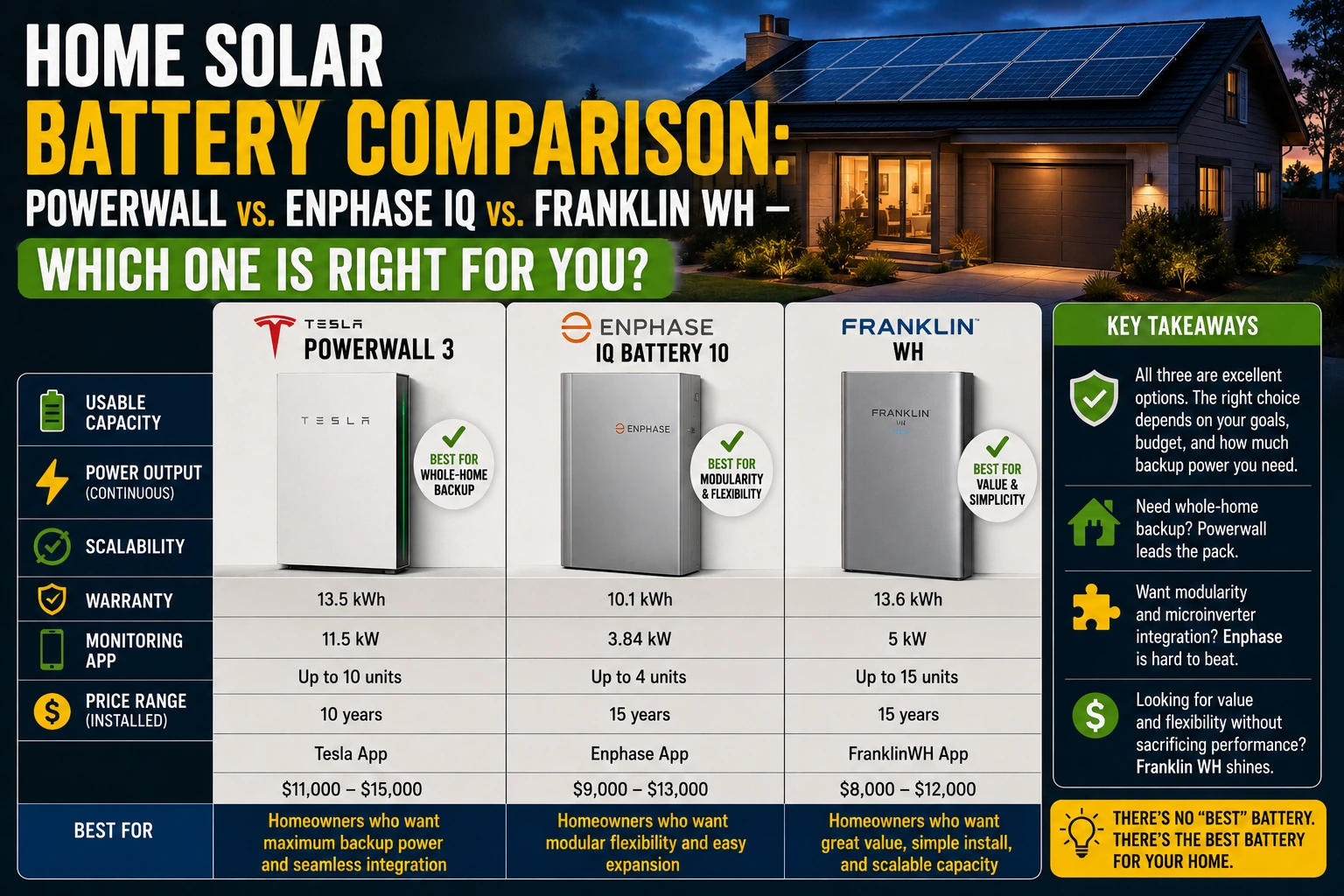

A reader left a comment on my Powerwall review last month that I’ve seen versions of a dozen times: “Great post — but my installer is quoting me a Franklin WH instead of a Powerwall. Is it worth pushing back?”
It’s a fair question, and the answer depends on what you’re optimizing for. I’ve owned a Tesla Powerwall 2 for two years and researched the alternatives thoroughly before buying. Here’s an honest comparison of the four home batteries that account for the vast majority of residential installs in 2025, with the specs that actually matter and the situations where each makes the most sense.
What to Look For in a Home Battery (Before the Brand Comparison)
Before comparing products, be clear on what you need the battery to do. The two primary use cases have different requirements:
Solar self-consumption optimization: You want to store midday solar surplus and discharge it in the evening, avoiding grid imports at peak rates. For this use case, you need enough capacity to cover your evening load (~5–10 kWh for most households) and enough continuous power output to run normal household loads (3–5 kW). You do not necessarily need whole-home backup capability.
Whole-home backup during grid outages: You need enough capacity and power output to run your critical loads — or your entire home — through a grid outage. Air conditioning, well pumps, and electric ranges are the loads that determine whether a battery can actually back up your home. These require higher peak and continuous power ratings, and often multiple battery units.
Most homeowners want both, but the backup use case drives the sizing decision. A battery that handles self-consumption but can only run a few lights and the refrigerator during an outage will be a disappointment to anyone who experienced Texas’s Winter Storm Uri or a Gulf Coast hurricane.
Tesla Powerwall 3 (Current Generation)
Specs:
- Usable capacity: 13.5 kWh
- Continuous power output: 11.5 kW (significant upgrade over Powerwall 2’s 5 kW)
- Peak power: 185A / ~22 kW for 10 seconds (handles motor start surges)
- Round-trip efficiency: ~97.5%
- Warranty: 10 years, 70% capacity retention guarantee
- Integrated inverter: Yes — Powerwall 3 includes a solar inverter, which changes the installation dynamic
- Approximate installed cost: $12,000–$16,000 (varies by region and whether it replaces or supplements existing inverter)
The Powerwall 3’s most significant change from the Powerwall 2 is the integrated solar inverter. This simplifies installation for new solar-plus-storage systems but creates complications for retrofits — if you already have solar with a separate inverter (like I do with Enphase microinverters), a Powerwall 3 doesn’t integrate as cleanly as a Powerwall 2 did. Tesla’s installer network tends to push Powerwall 3 for new combined installs and Powerwall 2 (now a legacy product but still installed) for retrofits.
I have a full two-year review of the Powerwall 2 with real-world numbers. The short version: it works as advertised for both self-consumption optimization and backup. The 11.5 kW continuous output of the Powerwall 3 makes it significantly more capable than my 2’s 5 kW for whole-home backup applications.
Best for: New solar-plus-storage installs where you want a single system and capable whole-home backup. Tesla’s app and monitoring are excellent. The name recognition also carries some resale value. Less ideal for retrofit onto existing non-Tesla solar systems.
Enphase IQ Battery 5P
Specs (per unit):
- Usable capacity: 5.0 kWh
- Continuous power output: 3.84 kW per unit
- Units can be stacked: up to 4 units (20 kWh, 15.36 kW continuous)
- Round-trip efficiency: ~89%
- Warranty: 15 years, 70% capacity retention guarantee
- Inverter: Microinverter-based — works natively with Enphase solar systems
- Approximate installed cost: $5,500–$7,000 per unit installed
The Enphase IQ Battery is the natural pairing for an Enphase microinverter system, which is exactly why I looked at it seriously before choosing the Powerwall 2. Its strongest selling point is native integration with the Enphase Enlighten monitoring ecosystem — if you’re running Enphase microinverters, adding an IQ Battery keeps everything in one app with seamless monitoring across panels and battery.
The modularity is genuinely useful. Start with one 5 kWh unit and add more later as budget allows or needs change. A single unit handles self-consumption optimization adequately for a moderate household. Two units (10 kWh) handles most whole-home overnight loads.
The tradeoffs: the 89% round-trip efficiency is measurably lower than the Powerwall’s ~97.5%, meaning more of your stored solar energy is lost as heat during charge/discharge cycles. Over a year of daily cycling, that efficiency gap adds up. The per-unit cost installed is also higher per kWh than a Powerwall — though total cost scales with how many units you install.
For whole-home backup with high-draw loads (central AC, well pump), you need at least 2–3 units and should confirm your contractor has calculated the power output adequately for your specific loads.
Best for: Enphase solar system owners who want native ecosystem integration and modular expansion. The 15-year warranty (vs Powerwall’s 10) is a genuine advantage for long-term value.
Franklin WH (Franklin Electric)
Specs:
- Usable capacity: 13.6 kWh
- Continuous power output: 5 kW (10 kW with two units)
- Peak power: 7.5 kW
- Round-trip efficiency: ~96%
- Warranty: 12 years, 70% capacity retention guarantee
- Inverter compatibility: Works with SolarEdge, Enphase (via AC coupling), and others — more flexible than Powerwall
- Approximate installed cost: $9,000–$12,000
The Franklin WH is the value proposition entrant in the premium home battery market. Similar capacity to the Powerwall at a typically lower price point, good round-trip efficiency, and broad inverter compatibility that makes it viable for a wider range of solar system configurations.
Marcus has installed a fair number of Franklin WH systems in the past 18 months and his take is consistent: “It performs well and the price is right. The app is less polished than Tesla’s, and field support when something goes wrong isn’t as established as Tesla or Enphase. But the hardware is solid and for customers where cost is the primary driver, it’s a legitimate option.”
The 5 kW continuous output — same as the older Powerwall 2 — limits whole-home backup capability for high-draw loads. For self-consumption optimization and partial backup (lights, refrigerator, some outlets), it’s fully adequate. For running central AC on battery, confirm the math with your installer.
Best for: Cost-conscious buyers who want near-Powerwall performance at a lower price point, particularly in non-Tesla solar system configurations where Powerwall integration is less clean.
Generac PWRcell
Specs:
- Usable capacity: 9–18 kWh (modular: 3 kWh increments via battery modules)
- Continuous power output: 6.7–9 kW (depending on configuration)
- Round-trip efficiency: ~96.5%
- Warranty: 10 years, 70% capacity retention guarantee
- Inverter: Requires Generac PWRcell inverter (system-specific)
- Approximate installed cost: $15,000–$22,000 (full system, varies with capacity)
The PWRcell is Generac’s entry into the solar-plus-storage market, leveraging their strong brand in the standby generator space. The modularity — adding battery modules in 3 kWh increments — allows fine-tuned capacity sizing, and the 6.7 kW+ continuous output handles more demanding backup scenarios than a single Powerwall 2.
The complication: the PWRcell requires the Generac-specific inverter, so it’s a full system commitment rather than a battery retrofit. Installed costs are typically higher than comparable Powerwall or Franklin configurations. Generac’s dealer network varies significantly in quality — the same concerns about contractor competence that apply to solar installers apply to PWRcell installers.
Best for: Homeowners building a new solar-plus-storage system who want higher continuous backup power than a single Powerwall and are comfortable with a higher total cost for the expanded capability.
Head-to-Head Summary
| Powerwall 3 | Enphase IQ 5P | Franklin WH | Generac PWRcell | |
|---|---|---|---|---|
| Usable capacity | 13.5 kWh | 5 kWh/unit | 13.6 kWh | 9–18 kWh |
| Continuous output | 11.5 kW | 3.84 kW/unit | 5 kW | 6.7–9 kW |
| Round-trip efficiency | ~97.5% | ~89% | ~96% | ~96.5% |
| Warranty | 10 years | 15 years | 12 years | 10 years |
| Approx. installed cost | $12–16K | $5.5–7K/unit | $9–12K | $15–22K |
| Best inverter pairing | Tesla/new installs | Enphase systems | Flexible | Generac PWRcell |
What I’d Do Today
If I were installing fresh with no existing solar system: I’d strongly consider the Powerwall 3 for a new combined install. The 11.5 kW continuous output meaningfully improves whole-home backup capability over anything else at its price point.
For a retrofit onto my existing Enphase system — which is the actual situation I faced in early 2023 — I’d weigh the Enphase IQ Battery more seriously than I did at the time, specifically for the native integration. I chose the Powerwall 2 partly because of Tesla’s brand and partly because of the stronger backup power output relative to a single IQ unit. With two IQ 5P units at 10 kWh / 7.68 kW combined, the comparison gets closer.
For cost-sensitive buyers: the Franklin WH deserves a serious look. The hardware is legitimate, the price is meaningfully lower, and for self-consumption optimization it performs comparably to the premium options.
Whatever you buy: have your installer calculate the backup power adequacy for your specific loads before committing. The theoretical specs matter less than whether the battery can actually run your air conditioner.
— Allen
