
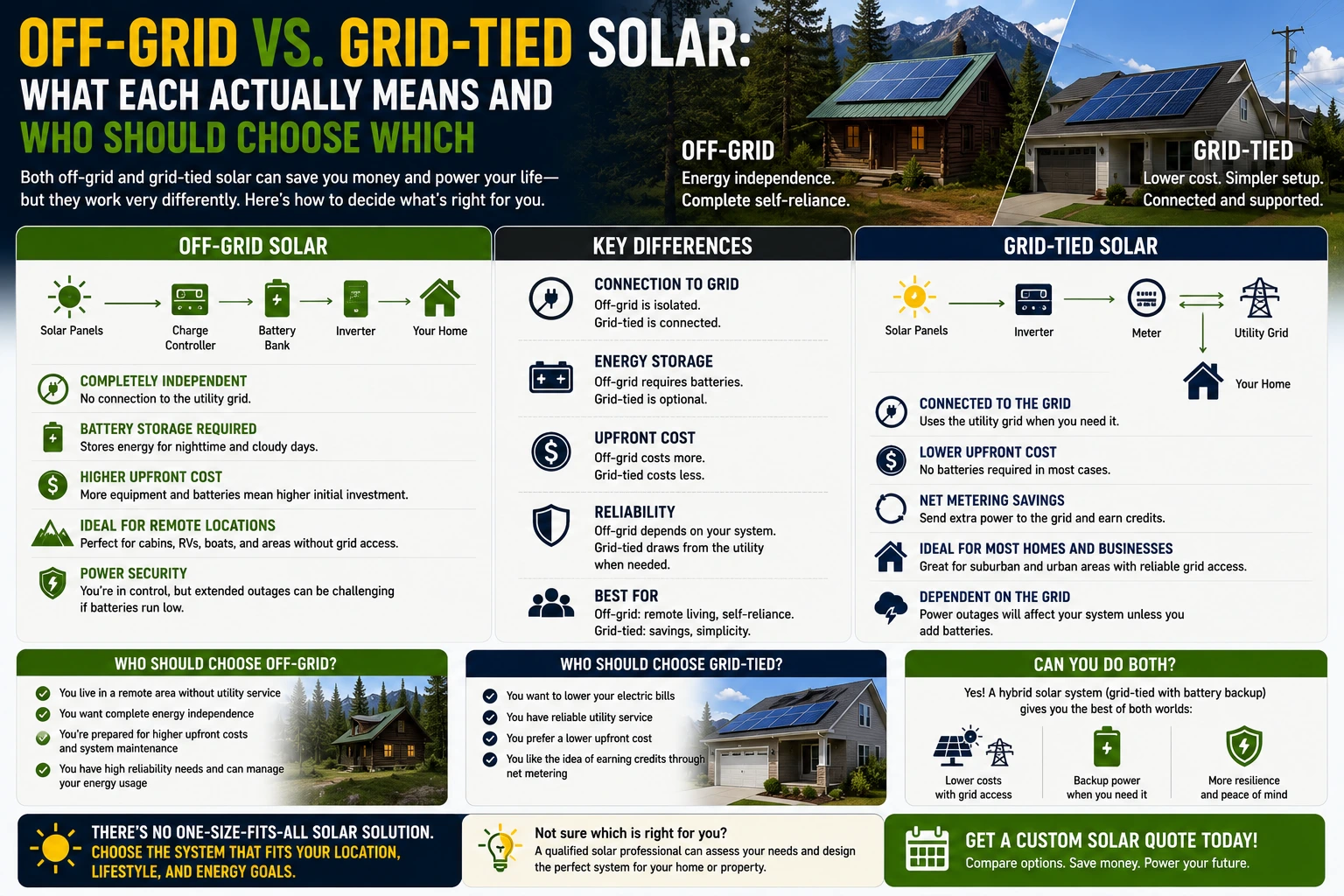

When most people picture solar panels on a house, they picture energy independence — no utility bill, no connection to the grid, self-sufficient on sunshine. It’s an appealing image. It’s also how almost nobody’s residential solar system actually works.
The overwhelming majority of residential solar in the United States is grid-tied. My 9.6kW SunPower system is grid-tied. Dave’s Sunrun system is grid-tied. Virtually every system you see on a neighborhood rooftop is grid-tied. The energy independence image is real in a limited sense — solar reduces your dependence on the grid — but complete disconnection from the utility is a different project entirely, with dramatically different costs and trade-offs.
Here’s what each configuration actually means, what it costs, and who should genuinely consider off-grid.
Grid-Tied Solar: How the Standard System Works
A grid-tied solar system connects your panels to the utility grid through your home’s electrical panel. When your panels produce more than your home is consuming, the excess flows to the grid — and you receive a credit on your bill through net metering. When your panels aren’t producing (nights, heavily cloudy days), you draw power from the grid as normal.
The grid functions as a limitless virtual battery. You bank production credits during sunny periods and spend them during low-production periods. There’s no storage required, no backup generator, no sizing for worst-case scenarios. The utility handles all of that seamlessly in the background.
What grid-tied does not do: It does not provide electricity during grid outages. Standard grid-tied inverters shut down automatically when grid power fails — this is a safety requirement, not a design flaw. When the grid goes down, your panels go dark even if the sun is shining. This is exactly the scenario Texas homeowners with grid-tied-only solar experienced during Winter Storm Uri in 2021.
Cost: Grid-tied systems are the least expensive solar configuration. No battery, no backup hardware beyond the inverter and panels themselves. A well-designed grid-tied system for a typical home runs $20,000–$35,000 gross before the ITC.
Grid-Tied With Battery Backup: The Hybrid Approach
Adding a battery (or batteries) to a grid-tied system creates what’s often called a hybrid or grid-tied-with-backup configuration. This is my own setup — SunPower panels, Enphase microinverters, and a Tesla Powerwall 2. The system stays connected to the grid for reliability and net metering but adds battery storage for two purposes: backup power during outages, and TOU optimization (storing cheap midday solar for expensive evening hours).
During a grid outage, the system “islands” — it disconnects from the grid, the battery and panels supply the home’s loads, and the system operates independently until the grid comes back. My Powerwall 2 provides 13.5 kWh of stored energy and 5 kW of continuous power. On a Texas summer outage, that runs my essential loads (refrigerator, lights, phone charging, fans, Enphase monitoring) for roughly 16–20 hours. Running central AC substantially shortens that window.
What it’s not: It’s not off-grid. It doesn’t eliminate the utility connection. It provides partial backup for hours to days, not indefinite independence.
Cost: Grid-tied system plus one Powerwall 3 currently runs approximately $30,000–$46,000 gross before ITC. Both the solar system and the battery qualify for the 30% federal tax credit.
Off-Grid Solar: What It Actually Requires
A true off-grid solar system has no utility connection. It must supply 100% of the home’s electricity needs from panels and battery storage alone, including during extended low-production periods — cloudy weeks, winter, equipment maintenance.
Designing a reliable off-grid system requires engineering for the worst-case scenario: what happens if you get 5 consecutive cloudy days in January with above-average consumption? The answer to that question determines how much battery capacity and panel capacity you need, and the answers are large.
Battery sizing for off-grid: A home consuming 30 kWh/day (approximately my pre-EV consumption) needs 3 days of autonomous storage as a minimum for weather resilience. That’s 90 kWh of battery capacity — approximately 7 Tesla Powerwall 3 units at $12,000–$16,000 installed each. Battery cost alone: $84,000–$112,000.
Panel oversizing for charging: Off-grid systems must charge batteries from panels on good production days while also covering daily consumption. This means significantly oversizing the panel array relative to daily use — typically 1.5–2x the panel capacity you’d install for a grid-tied system. For a 30 kWh/day home, that could mean 15–20 kW of panels where a grid-tied system might be 9–10 kW.
Backup generation: Most off-grid systems include a propane or diesel backup generator for extended low-production periods. The panels and batteries handle the routine load; the generator handles the once-a-year week of cloudy weather where batteries would otherwise run out. This adds $3,000–$8,000 in generator equipment plus ongoing fuel costs.
Realistic total cost for off-grid in a typical suburban home: $80,000–$140,000. Compared to $20,000–$30,000 for a grid-tied system (net of ITC). Off-grid costs 3–5x more for the same home — and still involves a generator for backup.
The Break-Even Math on Off-Grid
Off-grid makes economic sense when the cost of grid extension — running power lines from the nearest utility connection point to a remote property — exceeds the cost of the off-grid system.
Utility grid extension typically costs $15,000–$50,000 per mile, depending on terrain and local utility rates. Properties more than 1–2 miles from the nearest grid connection point are candidates where off-grid solar can be cost-competitive with grid connection on a pure capital cost basis.
For suburban and urban homeowners with existing grid connections, off-grid is almost never the economically rational choice. The grid is already there. You’re paying a fixed monthly connection fee to use it ($10–$25/month in most markets). Disconnecting from it would eliminate that fee — saving $120–$300/year — at a capital cost premium of $60,000–$100,000. That’s a 200–800 year payback on the additional cost. It doesn’t compute.
Who Should Seriously Consider Off-Grid
Remote rural property owners: If you’re building a home, cabin, or barn on land without existing grid access, and grid extension would cost $30,000–$80,000, off-grid solar is a legitimate competing option. Get quotes for both grid extension and off-grid solar and compare total 25-year cost of ownership.
Extreme energy independence priorities: Some homeowners have non-financial reasons for wanting grid independence — resilience against extended infrastructure failure, political or philosophical reasons for utility disconnection, or living in an area with frequent multi-day outages where the cost-benefit of full independence is more favorable than average. These are legitimate motivations; just understand the cost premium going in.
Cabins and vacation properties: Remote vacation properties that wouldn’t support the cost of grid extension are natural off-grid candidates. Lower daily consumption requirements (compared to a primary residence) reduce the battery and panel sizing requirements significantly, making the capital cost more manageable.
The Configuration Most Homeowners Actually Want
For the vast majority of US homeowners — suburban or urban, with existing grid access — the right configuration is not grid-tied-only or off-grid, but the middle path:
Grid-tied with one battery unit. Connected to the grid for reliability and net metering, with enough battery storage to handle outages of 12–24 hours for essential loads. This costs $30,000–$45,000 gross (before ITC), qualifies for the full 30% credit on both components, provides meaningful backup capability, and doesn’t require the $80,000+ commitment of true off-grid.
The total solar independence image is appealing, but the utility grid is actually a very cheap, very reliable battery that you’re already paying for through your connection fee. Using it as a backup while your panels do the heavy lifting is the economically rational approach for anyone who has access to it.
Off-grid is a real option for the right circumstances. It’s just not the right option for most of the people who romanticize it.
— Allen
