

Dave came over last summer with his first post-solar electricity bill, holding it like it contained a math problem he couldn’t solve. “I sent 400 kilowatt-hours to the grid last month,” he said. “My bill shows a credit of $31. But I thought I was getting full credit for what I produced.”
Four hundred kWh at Oncor’s standard residential rate would be worth about $52. He got $31. The difference wasn’t a billing error — it was a function of how his specific utility structures solar compensation, which is different from what his installer’s sales pitch implied when they described “net metering.”
Net metering is the most important policy lever in residential solar economics, and it varies more than almost any other factor. Here’s how it actually works, what the variations mean for your payback, and how to find out exactly what you’re getting before you sign an install contract.
The Basic Concept
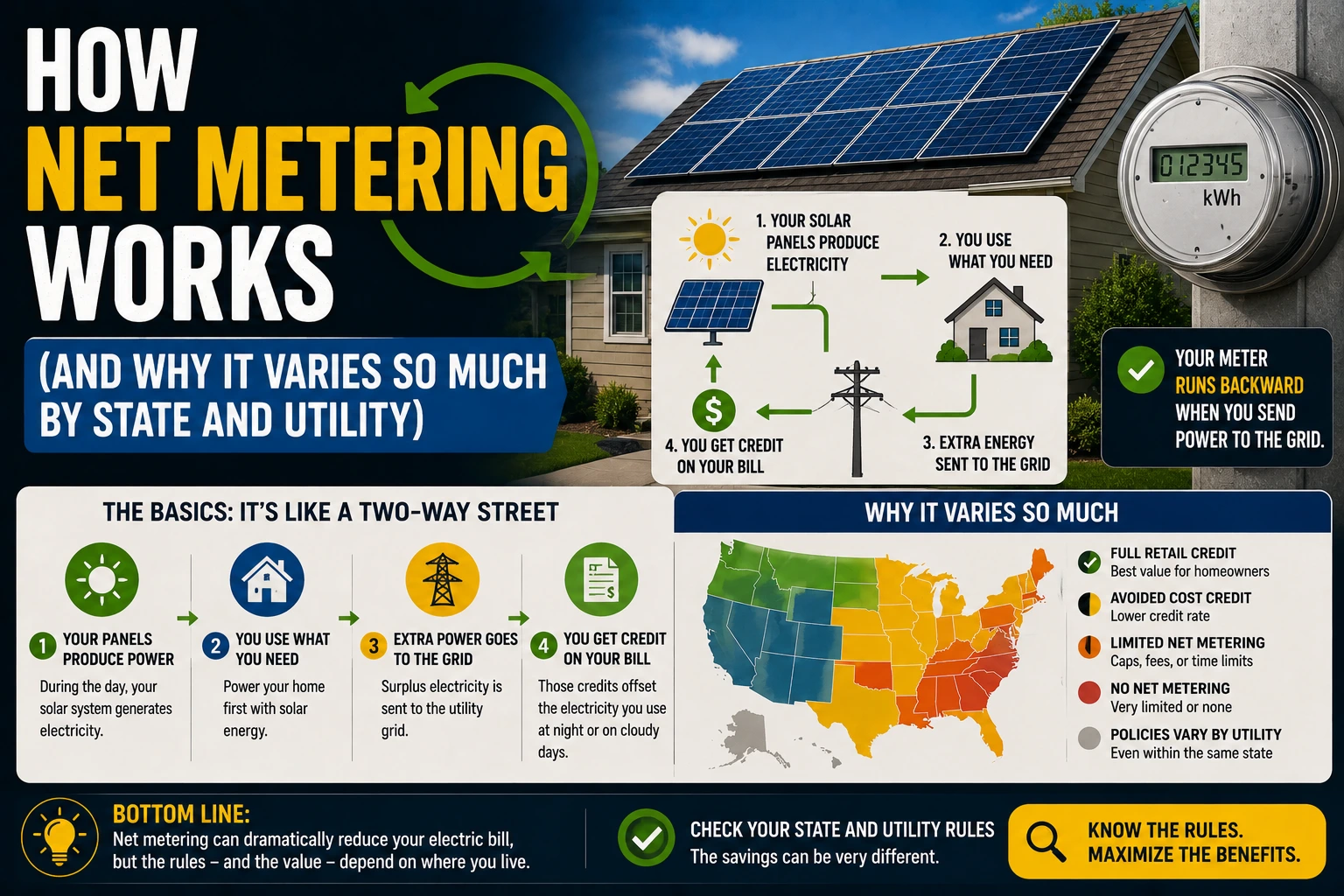
Net metering, in its purest form, works like this: your utility meter measures electricity flowing in both directions. When your solar panels produce more than your home is consuming at that moment, the excess flows to the grid and the meter runs backward — or credits your account at the same rate you’d pay to buy electricity. When your panels aren’t producing (nighttime, cloudy days), you draw from the grid and the meter runs forward at the normal retail rate.
At the end of each billing cycle (or year, depending on your utility’s structure), you pay only the net of what you consumed minus what you produced. If you produced more than you consumed in a period, you carry a credit forward to offset future bills.
In theory: every kWh you produce is worth exactly as much as every kWh you consume. In practice: very few utilities still offer this.
The Spectrum of Solar Compensation Policies
Full retail net metering is what most people imagine when they hear the term. You export 1 kWh, you get a credit worth exactly 1 kWh at the retail rate. If your retail rate is $0.13/kWh, you get $0.13 in credit for every kWh you export. States with strong consumer protection laws or active solar lobbying tend to preserve this structure: New Jersey, Massachusetts, New York, Maryland, Illinois, and portions of Texas (Austin Energy and CPS Energy) still offer rates close to full retail value for solar exports.
Avoided-cost or wholesale net metering is what many utilities have shifted to under regulatory pressure from utilities arguing that full retail net metering forces non-solar customers to subsidize solar customers. Under this structure, exported kWh are credited at the utility’s avoided cost — the wholesale price of electricity on the regional market — which typically runs $0.03–$0.07/kWh. That’s a 50–75% reduction in the value of every exported kWh versus full retail.
Custom export rates sit between these extremes. California’s NEM 3.0 created a specific export rate called the Avoided Cost Calculator rate — currently averaging around $0.05/kWh, with some time-of-use variation. Arizona’s APS uses the Resource Comparison Proxy at approximately $0.077/kWh. These are better than pure wholesale but significantly below retail.
No net metering — some utilities, particularly rural electric cooperatives and some municipal utilities, simply do not offer net metering at all. You produce solar, you consume what you produce in real time, and any excess export is purchased at a nominal wholesale price or not compensated at all. In these service territories, battery storage is essentially mandatory for solar to make financial sense.
Monthly vs. Annual True-Up
How frequently your utility reconciles your net usage makes a meaningful financial difference.
Monthly netting: Credits from excess production expire at the end of each billing month. If you produced 400 kWh more than you used in July, that credit applies to your July bill. Any leftover doesn’t carry to August.
Annual true-up: Credits accumulate over a 12-month period and are reconciled once per year. This is significantly better for solar economics in climates with seasonal variation. You can bank surplus summer production as credits and draw them down against winter bills when production is lower. California’s NEM structure (even post-3.0) uses annual true-up. Austin Energy uses annual true-up.
The annual structure is what allows a properly sized system to effectively zero out your annual bill even if individual months show a negative credit balance in winter.
Net Metering vs. Net Billing: A Distinction That Matters
These terms are used interchangeably in casual conversation but mean different things in utility tariff language.
Net metering: The meter literally measures net usage — production and consumption are offset in real time, and you’re billed on the difference. Excess production earns credits at whatever the applicable rate is.
Net billing (or net energy billing): Production and consumption are measured and billed separately. Your solar production is credited at one rate; your grid consumption is billed at a (usually higher) retail rate. In practice, this often produces similar results to metered net metering, but the billing structure is different and the rates applied to each direction may differ.
When an installer tells you your utility has “net metering,” ask specifically: what is the export compensation rate? What is the retail rate I pay for imports? If those two numbers are significantly different, you have net billing rather than true net metering — and your production estimates should reflect the export rate, not the retail rate.
How Net Metering Affects Your System Design
The export compensation rate your utility offers should directly influence how you size your system and whether you add battery storage.
With full or near-full retail net metering: Exporting to the grid is nearly as valuable as self-consumption. You can size your system to maximize annual production without worrying much about whether you’ll self-consume it all — exports earn close to full value. This is the model that made solar pencil out so cleanly in California through 2022.
With reduced export rates (avoided-cost or similar): Every kWh you export is worth 40–70 cents on the dollar compared to self-consumption. In this environment, there’s a strong incentive to:
- Size the system to match consumption more closely (rather than over-producing)
- Add battery storage to capture midday surplus for evening self-consumption instead of exporting it
- Shift discretionary loads (EV charging, laundry, dishwasher) to midday solar production hours
This is the same strategic shift that made battery storage effectively necessary in California after NEM 3.0, and why Arizona’s APS and SRP territories make the solar-plus-battery combination more attractive than solar alone.
In Texas, net metering policy varies by utility. Austin Energy — my utility — offers a Value of Solar rate that provides consistent export compensation, and annual true-up. CPS Energy in San Antonio has its own structure. The Texas solar picture is utility-specific in ways that make the state-level question less meaningful than the specific utility question.
How to Find Out What You’re Actually Getting
Before signing any solar contract, find your specific utility’s net metering tariff. Not the installer’s description of it — the actual filed tariff document. Every US utility files rate tariffs with their state public utility commission, and these are public records.
What to look for in the tariff document:
- The export compensation rate (in $/kWh or as a reference to another rate)
- Whether it’s metered net metering or net billing
- Monthly vs. annual true-up structure
- Any cap on system size eligible for net metering
- Interconnection fees or standby charges that apply to solar customers
The DSIRE database (Database of State Incentives for Renewables and Efficiency) maintains state-level net metering policy summaries, though they can lag behind the most recent utility filings. For current specific rates, go directly to your utility’s website and search for their solar or net metering tariff, or call their interconnection department.
When Dave figured out his utility’s actual export rate, his payback estimate extended by about 18 months compared to what his installer had projected using full retail credit. That’s a real difference — not a disaster, but something he wished he’d known before signing.
The information is available. You just have to ask for it specifically, and know what question to ask.
— Allen
