

Most of the solar content online has a financial interest in you going solar. The “educational” articles are often backed by installers. The comparison tools get paid when you request a quote. The review sites earn commissions when you convert.
I’m not saying solar is a bad investment — my $338 Austin electricity bill is now $22, and I’ve written about that in enough detail elsewhere. But the information environment around solar is about as unbiased as a car dealership’s brochure. Which means the due diligence has to come from you.
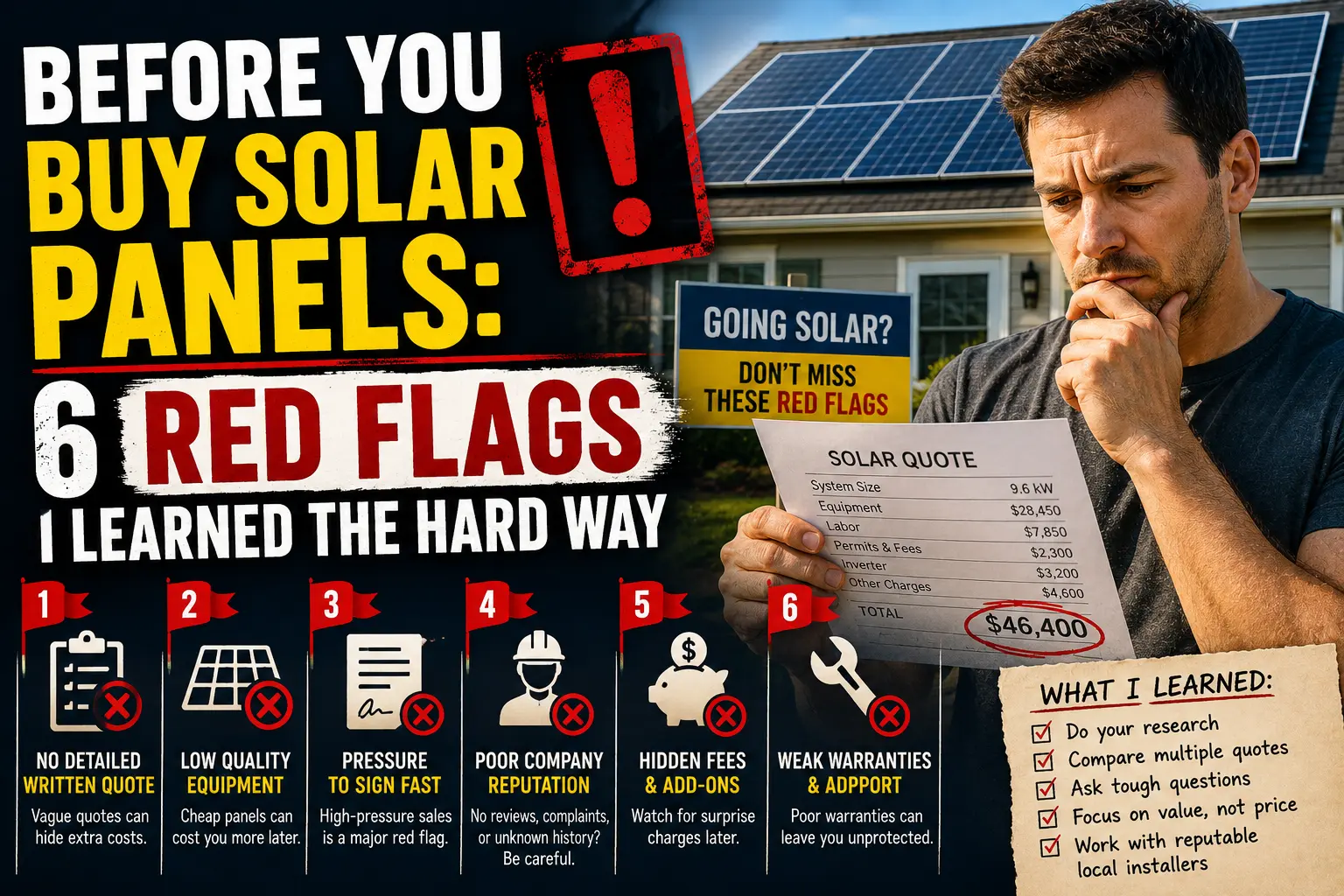
These are the six things I either missed, nearly missed, or learned the hard way. Marcus — my installer contact in Houston with nine years in the industry — confirmed every single one of them is standard practice.
Red Flag #1: The Production Estimate That’s Always Just Right
Every solar company will show you a production estimate — the number of kWh their system will generate on your roof each year. And almost every estimate I reviewed came back suspiciously close to 100% of my current usage, or slightly above.
That’s not a coincidence. It’s a sales technique.
An honest production estimate depends on precise shading analysis at every hour of every day across all seasons, the specific panel degradation curve, your utility’s net metering structure, and your actual usage trajectory — not just last year’s bills. “Most companies use PVWatts with optimistic shading inputs,” Marcus told me. “The 5% overestimate is basically baked in industry-wide.”
NREL’s PVWatts Calculator is publicly available and free. Run your own address through it with honest shading inputs before accepting any installer’s number as gospel.
What to do: Ask the installer to show you their shading analysis file — the actual hourly irradiance data for your specific roof sections. If they won’t, their estimate is a black box.
Red Flag #2: The Oversized System
One of the companies I didn’t choose during my quote process recommended a 13.2kW system for my house. My actual usage didn’t support anything above 10kW. When I pushed back, the rep called the extra capacity “future-proofing.”
An oversized system is almost always better for the installer’s margin and worse for your wallet. It sounds reasonable — plan for an EV, a room addition, higher future usage. What they don’t tell you is that most utilities cap how much excess generation they’ll credit you for, and in many states, excess credits expire rather than roll over indefinitely.
The Department of Energy’s homeowner solar guide is straightforward on this point: system size should match your actual usage history, not a hypothetical future load.
What to do: Pull your last 12 months of utility bills and calculate your real annual kWh usage. A correctly sized system should cover 90–110% of that number — not 140%.
Red Flag #3: The Missing Permit Line Item
This nearly got me with the lowest quote I received — $23,400 for a 9.8kW system, which looked attractive until I asked for a full breakdown and found that city building permit fees and utility interconnection costs were not included. In Austin, those two items added $1,050. In California, permit fees alone can run $2,000–$4,000 depending on jurisdiction.
It’s not always technically dishonest — permits are sometimes buried in fine print as “additional costs.” But a quote presented without them is structured to look cheaper than it is. When I compared all six quotes I received and broke down exactly what each one included and left out, this was one of the most common gaps.
What to do: Ask directly: “Does this quote include all permit fees, city building permit fees, and utility interconnection application fees — listed as separate line items?” Anything other than a clear yes with numbers is an incomplete quote.
Red Flag #4: The Warranty That Isn’t From Who You Think
Nearly every solar company advertises a 25-year warranty. Most of those warranties are not what they appear to be.
A standard warranty package has three components: panel manufacturer warranty (from the panel company), inverter warranty (from the inverter company — often 10–12 years), and installation/labor warranty (from your installer). The labor warranty is the one that varies most — and the one most likely to become worthless if your installer closes.
The US residential solar market has seen consistent installer consolidation and bankruptcy. Marcus watched clients of small operators get stranded during the 2019–2020 industry slowdown — their systems were fine, but the company that installed them no longer existed to handle service calls or warranty claims.
What to do: Ask whether the labor warranty is backed by the installer directly or a third-party warranty servicer. If it’s a third party, get the servicer’s name and research them. SunPower’s integrated warranty — product, performance, and labor all through one entity — was a significant factor in why I chose them for my own install.
Red Flag #5: The “No Money Down” Framing
Financing solar is a legitimate option. A zero-down solar loan at 6.99% APR over 20 years is still a real financial product with real interest costs — typically $8,000–$14,000 in total interest on an average-sized system over the loan life.
The way many installers frame financing papers over this completely. “Your monthly payment will be less than your current electric bill” is sometimes true — but it compares the loan payment to your old electricity bill, not to your post-solar electric bill plus your loan payment. I’ve seen homeowners sign paperwork thinking they’d immediately come out ahead, then realize the savings were much narrower than the rep implied.
What to do: If you’re financing, do this yourself: multiply the monthly payment by the total number of payments, then subtract the system cost. That number is your total interest paid. Weigh it against your projected lifetime savings before you sign.
Red Flag #6: No Reference From a Two-Year-Old Install
This is the most reliable signal I found — and the simplest. Any installer worth hiring can produce three references from customers whose systems have been running for at least 18–24 months.
If the references they offer are from customers who’ve had solar for four or five months, that’s not a reference. It’s a testimonial. A system that’s been running for four months hasn’t been through a full annual production cycle, a complete billing reconciliation, or any meaningful post-install service interaction.
Dave — my neighbor who went solar six months after I did, through a different company — had a panel underperforming by his first winter. His installer resolved it, but it took two visits and more back-and-forth than it should have. He told me later he never asked for references before signing. The installer’s Google reviews looked fine. That’s not the same thing.
While you’re doing your research, check your state’s solar incentive database at DSIRE — it lists every state rebate, net metering policy, and solar tax incentive, updated regularly by NC State University. It’s significantly more reliable than what any individual installer tells you about “available local incentives.”
What to do: Ask for three references. Call them. Ask specifically: did the system perform to the installer’s estimate? Was there any service issue in the first two years? How did the company handle it?
None of this is meant to talk you out of going solar. The financial case for most US homeowners in 2025 is genuinely strong — the 30% federal tax credit alone changes the math considerably, and utility rates are not heading down.
But the industry’s incentives are not always aligned with yours. The best protection is treating this like any major purchasing decision: specify your requirements before you talk to anyone, insist on comparable line-item quotes, read the fine print, and talk to people who’ve been through it.
The six red flags above cost me time to find. Hopefully they cost you less.
— Allen
