
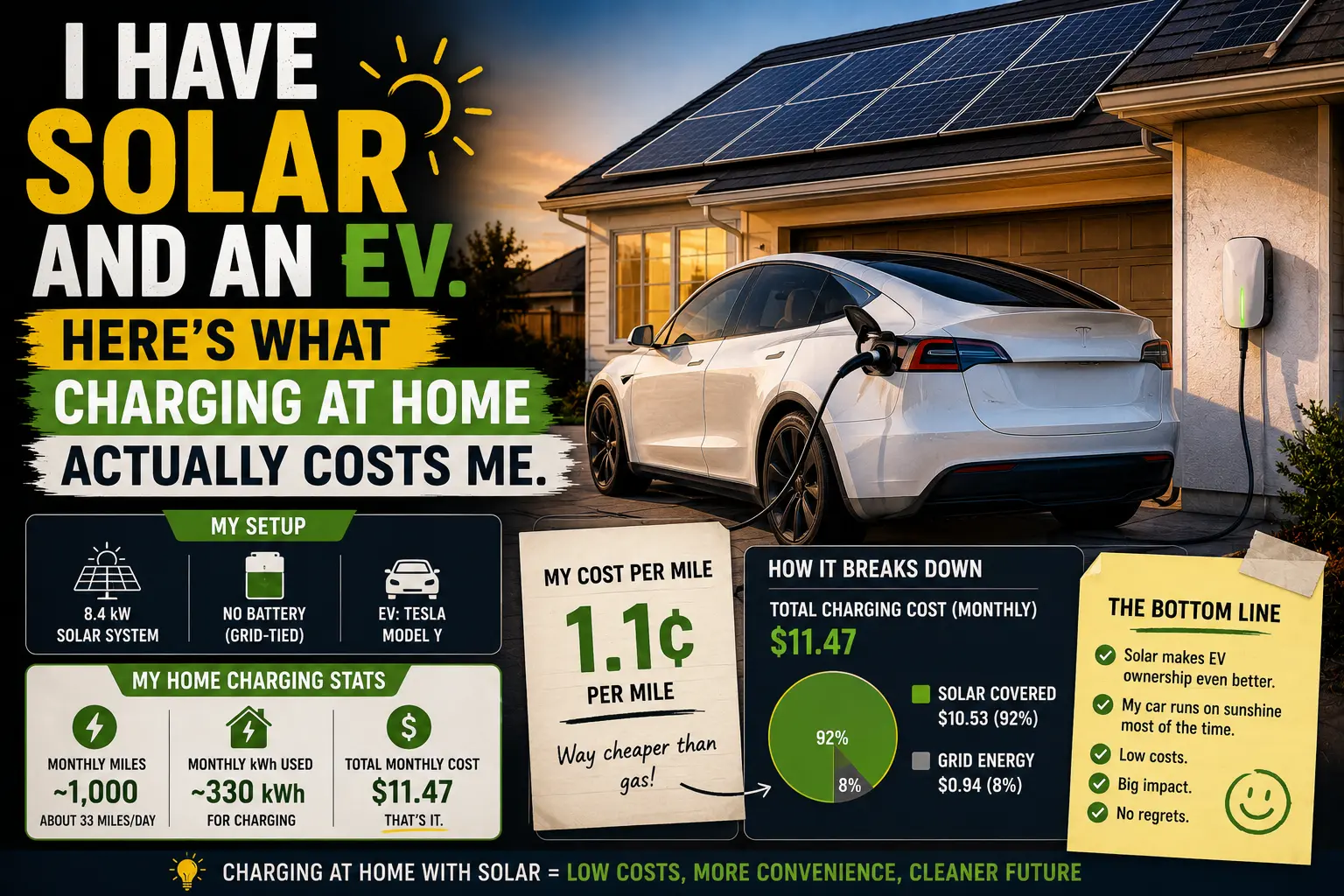

$0.011 per mile. That’s what it costs me to drive my Chevy Bolt on solar power.
For comparison, a typical gas car at 30 mpg and $3.40/gallon costs $0.113 per mile in fuel. My neighbor Dave is still on gas. We drove to the same hardware store last month and I mentioned the math on the way back. He was quiet for a moment, then said: “So you’re driving for basically free.”
Not quite free — the solar system cost money, and that cost amortizes into every solar-powered mile I drive. But in terms of ongoing per-mile fuel cost, yes. Close to free. Here’s how the numbers actually work.
My Setup
- Car: 2021 Chevy Bolt EV (65 kWh battery, EPA-rated 259 miles range)
- Charger: Level 2 EVSE (ChargePoint Home Flex, 32 amp / 7.7 kW) in garage
- Solar system: 9.6kW SunPower Maxeon, installed November 2022
- Battery: Tesla Powerwall 2 (added March 2023)
- Location: Austin, TX — Austin Energy territory
- Annual driving: roughly 11,400 miles (I tracked it)
I bought the Bolt in January 2022 — about ten months before the solar went live. For those ten months, I charged entirely from the grid at Austin Energy’s residential rate. That gave me a clean baseline to compare against.
The EV Electricity Cost Without Solar
The Bolt gets approximately 3.5 miles per kWh in Austin conditions — slightly below EPA rating because Texas summers mean AC running while driving, which draws additional power.
At 11,400 miles/year and 3.5 miles/kWh, I need roughly 3,257 kWh per year to run the car.
At Austin Energy’s blended residential rate of $0.117/kWh (my average across my tiered rate structure), that’s $381/year to charge from the grid. About $32/month.
For context: a comparable gas car at 30 MPG and $3.40 average Texas gas price costs $1,292/year in fuel for the same mileage. The EV is already $911/year cheaper before solar enters the picture.
The Department of Energy’s EV cost comparison tool calculates this precisely for any vehicle pairing — worth running your own numbers if you’re considering an EV.
What Changes When Solar Enters the Picture
My 9.6kW system produced 14,312 kWh in its first full year (2023). My household used approximately 12,100 kWh — everything: HVAC, appliances, lighting, and the Bolt.
The Bolt’s 3,257 kWh represents about 27% of my total household electricity consumption.
Here’s the honest framing: I can’t literally say “my car runs on solar” because electrons don’t carry routing tags. What I can say is that my solar system produces more than enough to cover both my house and my car combined, with surplus that goes back to the grid for credit. The economic effect is the same as if the car ran directly on solar.
The $381/year I was paying to charge from the grid essentially disappeared into my overall solar savings. My annual electricity bill — house plus car — went from approximately $3,530 (house only, pre-solar) plus $381 (car charging) to a combined $276/year post-solar.
That’s a $3,635 annual reduction covering both the house and the EV.
The Per-Mile Math
$381/year for 11,400 miles = $0.033/mile charging from the grid.
When that cost effectively goes to zero under solar (absorbed into the overall system savings), the ongoing fuel cost drops to the grid connection fee allocated to the car’s share — roughly $0.011/mile when you divide the $130/year grid connection fee across total kWh usage including the car.
That $0.011/mile figure is not free, but it’s as close to free as driving gets in 2025.
The amortized cost of the solar system itself adds back roughly $0.016/mile over the system’s 25-year life (system net cost $19,880 ÷ 25 years ÷ 11,400 miles/year). So the true all-in solar-allocated cost of driving is closer to $0.027/mile — still less than a quarter of the gas equivalent.
Sizing Solar for an EV: The Question Most Installers Get Wrong
If you’re planning to add both solar and an EV — or already have one and are adding the other — the sizing question is critical and frequently mishandled.
The mistake I see in installer pitches: sizing the solar system to cover historical household usage only, then adding the EV afterward and finding the system undersized. If you’re adding an EV at the same time as solar, or within the next 2–3 years, add the EV’s electricity demand to your baseline before sizing the system.
My Bolt needs 3,257 kWh/year. At Austin Energy’s rate, that’s equivalent to adding about 28 kWh/day to my load profile. A solar system sized to cover only my pre-EV house usage would have been 8.2kW — enough for the house, short for the car.
My installer knew about the Bolt and sized the 9.6kW system to cover combined usage. That decision meant I didn’t need to go back and add panels later. If you’re in the quote process now and have an EV or plan to get one, tell every installer upfront and require that the production estimate includes the car’s consumption.
According to NREL’s research on residential solar and EV pairing, homes that size solar systems to account for EV charging save significantly more over the system’s life than those who add EVs as an afterthought to an undersized install.
Charging Timing and the Powerwall Connection
Here’s a detail that doesn’t come up often enough: when you charge your EV matters as much as whether you charge from solar.
Without a battery, the most solar-efficient charging window is midday — when panels are producing at peak and you can set the car to start charging at, say, 11 AM and stop at 3 PM. Many Level 2 chargers (including the ChargePoint I use) have scheduling features for exactly this.
With the Powerwall, my setup is more flexible. The battery stores excess midday production, and I typically charge the Bolt in the early evening using stored solar — which also keeps the charging load off the grid during Austin Energy’s peak demand window. This isn’t necessary for the math to work, but it optimizes it.
Claire was the one who suggested I actually track this. “You keep talking about the car costing nothing to drive. Do you actually know if that’s true?” She was right to push — the tracking confirmed it, but without the monitoring data I’d have been estimating.
Is It Worth Adding Solar Specifically for an EV?
This is the version of the question that homeowners without solar often ask when they’re considering both at once. The short answer: if the solar economics work for your house on their own, the EV makes them meaningfully better. If the solar economics are marginal for your house alone, the EV makes a real difference in tipping the calculation.
Here’s why: every kWh your solar system produces that you consume (either house or car) is worth your full retail electricity rate in savings. Every kWh you export to the grid under most net metering policies is worth less — sometimes significantly less, as California homeowners discovered after NEM 3.0. An EV increases your home consumption, which means more of your solar production gets consumed at full retail value rather than exported at reduced credit rates.
In practice, an EV added to a solar household typically shortens the solar payback period by 6–18 months, depending on your utility’s net metering rate and how much of your EV charging comes from solar production versus grid power.
The combination is genuinely one of the better personal finance moves available to a US homeowner in 2025 — if you have the roof for solar and can use the federal EV tax credit alongside the solar tax credit in the same or adjacent tax year. The cost and tax credit math I walked through for my solar system applies to both: the 30% solar credit and the up-to-$7,500 EV credit are separate, stackable, and both reduce your federal tax liability dollar for dollar.
That’s a lot of credits for one tax year. Worth planning around.
— Allen
