
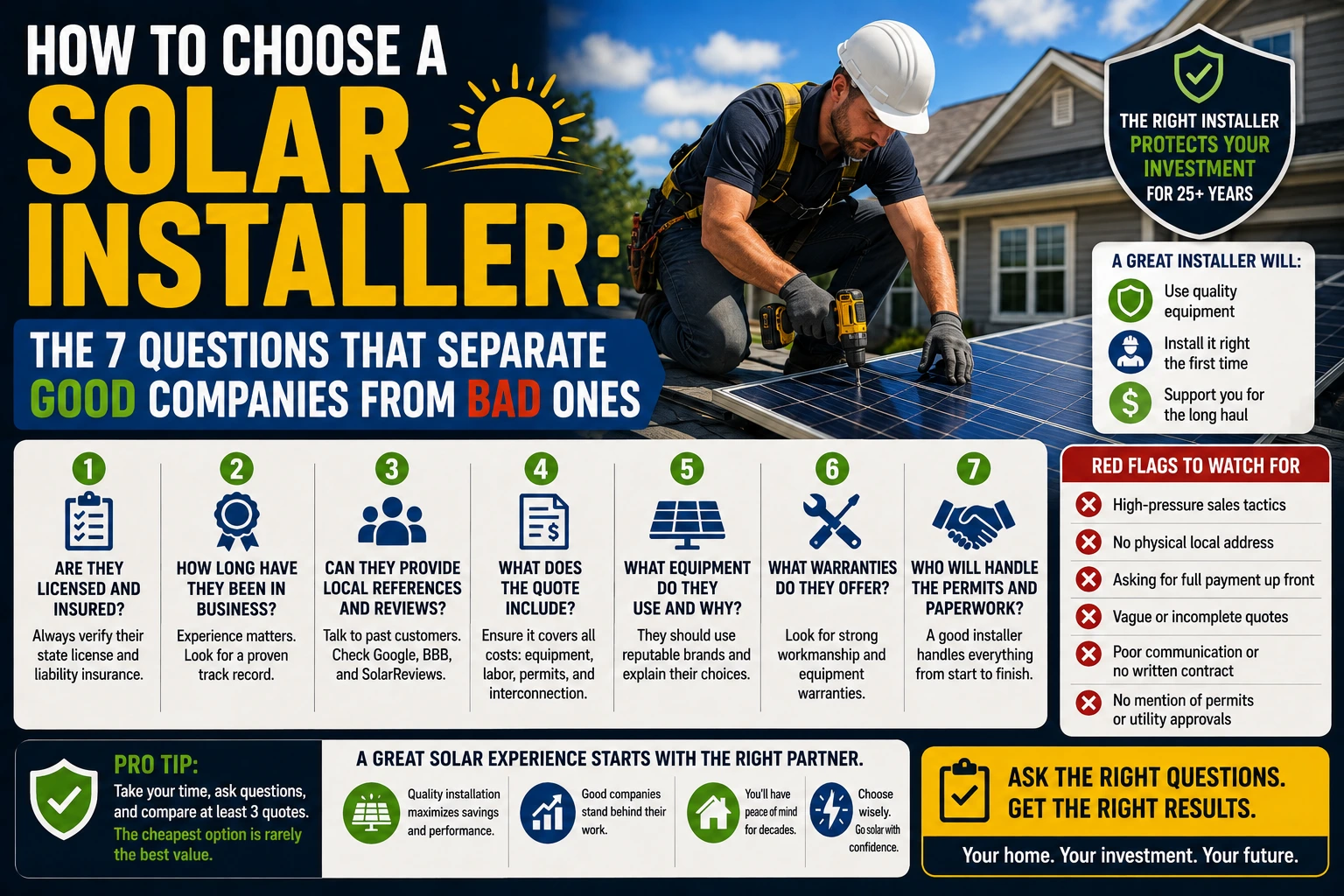

The panel brand on your roof matters less than who installs it.
I know that’s a strong statement. But after getting six quotes, talking to Marcus extensively about what he sees on the installer side, and hearing enough post-install horror stories from Dave’s circle of Sunrun customers, I’m confident: a mediocre panel installed by a skilled, accountable company will outperform a premium panel installed by a sales-first operation that disappears after the permit closes.
The solar industry has a contractor quality problem. Low barriers to entry, high demand, and aggressive third-party lead generation have created a market where the distance between the best and worst installers is enormous — and the sales pitch rarely helps you tell them apart. These seven questions will.
Question 1: Are Your Installers NABCEP-Certified?
NABCEP — the North American Board of Certified Energy Practitioners — is the solar industry’s professional certification body. A NABCEP-certified PV Installation Professional has passed a rigorous exam covering system design, electrical code, and installation best practices. It’s the closest thing the industry has to a licensed electrician equivalent for solar.
Not every installer on every job needs to be NABCEP-certified — but every company doing residential installs should employ at least one, and that person should be involved in design review and quality control for your installation.
When you ask this question, watch the response. A confident “yes, here’s our certified installer’s name and NABCEP ID” is the answer you want. Vague answers about “certified technicians” or pivoting to manufacturer training certifications are a yellow flag. You can verify NABCEP credentials directly at nabcep.org.
Question 2: How Long Have You Been Installing in This Specific County or Utility Territory?
Solar permitting is local. Every county has its own building department with its own review process, timelines, and quirks. Every utility has its own interconnection process, paperwork requirements, and inspector relationships. An installer who has done 500 installs in Phoenix may be a slow, error-prone newcomer in Austin — because the local permit process, utility interconnection, and inspection requirements are completely different.
Ask specifically: how many installs have you completed in [your county] in the past 12 months? Do you have an established relationship with [your utility’s] interconnection department?
Companies that operate multi-state or multi-market at scale often subcontract to local installers — which is fine as long as the subcontractor has genuine local experience. Ask who will actually be doing your installation and whether they’re an employee or subcontractor, and ask the same questions about local experience for whoever the actual crew is.
Question 3: Can You Provide Five References From Installs Completed in the Last 12 Months?
Not testimonials on their website. Not a Google Reviews link. Five actual customers from recent installs, with phone numbers, that you can call.
Any legitimate company with a real local track record can do this immediately. Companies that hesitate, offer to “follow up with references,” or steer you toward curated testimonials instead are showing you something.
When you call the references, ask three things:
- Did the project complete on the timeline they promised?
- Was there anything they didn’t tell you before signing that you wished you’d known?
- If something went wrong, how did they respond?
That third question is the most revealing. Every install has something that doesn’t go perfectly. The quality of a company is demonstrated most clearly in how they handle problems, not how smoothly everything goes when nothing goes wrong.
Question 4: What Is Your Post-Install Support Process — Who Do I Call, and How Quickly Do You Respond?
This question exposes whether a company has a real service infrastructure or is primarily a sales organization.
A good answer is specific: “You call this number, you’ll reach our service team, typical response time for non-emergency issues is 48–72 hours, emergency issues same-day.” They should be able to tell you whether service calls are covered under a workmanship warranty (and for how long), whether they handle equipment warranty claims on your behalf, and whether they have a dedicated service team or whether post-install support is handled by the same sales staff who signed you up.
A bad answer: vague assurances about “great customer service” and a redirect to their reviews page. After your install is done, you are no longer a revenue opportunity for the sales team — you’re a cost center for the service team. Companies that have not invested in the latter are the ones where customers wait three weeks for a callback when something goes wrong.
Marcus’s version of this advice: “Ask them what happens if you call on a Tuesday afternoon with a monitoring alert showing one panel offline. Who picks up the phone?” The answer to that hypothetical is highly predictive of the actual experience.
Question 5: Do You Pull the Permits Yourself, or Does Something Else Happen?
The correct answer: “We handle all permitting and inspections as part of the installation process. You don’t need to do anything.”
Variations that warrant follow-up questions:
- “We use a third-party permit expediting service” — common and acceptable, but confirm the timeline and that this is included in the quoted price
- “We’ll provide you the permit documents to submit” — this is you doing their work; not standard for a full-service installer
- “Permits aren’t always required for your system size” — possibly true for very small systems in some jurisdictions, but worth verifying independently; unpermitted solar can create insurance and resale complications
The permit process isn’t just paperwork. The final inspection is what confirms your system was installed to code and is safe to operate. Installers who discourage, rush, or work around the permit process are creating liability for you.
Question 6: What Inverter Brand Do You Use, and Why?
This question isn’t about the answer — it’s about whether they can have a competent technical conversation with you.
A good installer should be able to explain: what inverter brands they offer, the tradeoffs between microinverters and string inverters (or string inverters with optimizers), and why they’re recommending what they’re recommending for your specific roof and shading profile. They should ask you about shading, roof orientation, and whether you have any plans to add an EV or additional loads.
If the sales rep can’t explain the microinverter vs. string inverter tradeoff or deflects the question to “we use the best equipment,” that’s a signal about the technical depth of the company overall. I covered the inverter comparison in detail — go into this conversation knowing the basics, and the quality of their response will tell you a lot.
Question 7: Show Me the Production Estimate With All Assumptions Spelled Out
Every installer will give you an annual production estimate in kWh. What you want is the document behind the number — the production model showing:
- Software used (PVWatts, HelioScope, Aurora, or similar)
- Roof azimuth and tilt assumptions
- Shading analysis (ideally with an actual site assessment, not guessed)
- Temperature derating applied
- System losses (wiring, soiling, inverter efficiency)
- Degradation rate applied over the analysis period
This matters because two installers can look at the same roof and produce production estimates that differ by 15–25% — not because the physics of solar are different, but because one used optimistic assumptions and the other used realistic ones. An overstated production estimate makes the payback period look shorter and the monthly bill comparison look better. It’s one of the most common ways misleading solar proposals are constructed.
If an installer can’t or won’t show you the assumption inputs behind their production estimate, that’s a significant red flag — covered in my earlier breakdown of what to watch for in solar quotes. The number matters less than how it was calculated.
The Shortlist Process
After running these seven questions across my six installer quotes, two companies dropped off immediately (couldn’t provide references on request, vague on inverter rationale), two were credible but not local specialists, and two were clearly the serious options. Of those two, one was meaningfully more expensive and one had a slightly more experienced local permit track record. I went with the local specialist.
The price gap between my chosen installer and the second-best option was $1,400. The piece of mind from knowing exactly who I called if something went wrong, and knowing they’d answer, was worth more than that spread.
— Allen
