
When I was comparing quotes for my Austin install, three of the four companies specified different inverter setups without explaining why. One quoted Enphase IQ8 microinverters. Two quoted SolarEdge string inverters with power optimizers. One quoted a basic string inverter with no optimizers at all.
The price difference between the cheapest and most expensive inverter configurations was about $2,800 on otherwise comparable quotes. Nobody volunteered an explanation for why. I had to ask.
The inverter choice is one of the most consequential decisions in a solar installation — arguably more important than panel brand for long-term system performance — and it’s one most homeowners don’t understand when they’re signing contracts. Here’s what I learned, including what I chose and why, and what Marcus told me about how installers actually make this decision.
What an Inverter Does (The 30-Second Version)
Solar panels produce direct current (DC) electricity. Your home runs on alternating current (AC). An inverter converts DC to AC. Every solar system has one — the question is what kind, and where it sits in the system.
That’s the whole job. The differences in how that job gets done are what determine your system’s real-world performance, monitoring capability, safety profile, and long-term maintenance costs.
String Inverters: How They Work
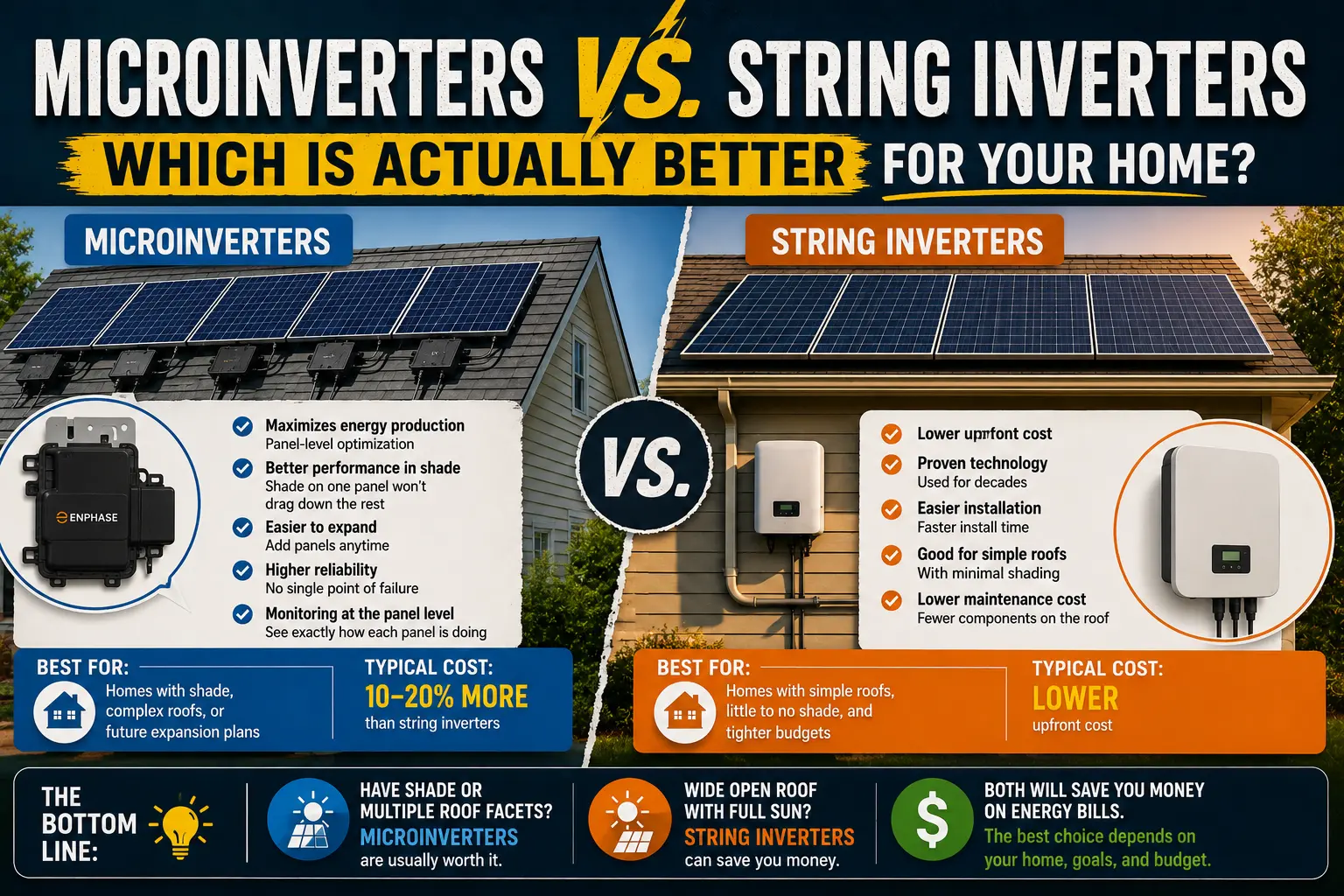
A traditional string inverter connects all your panels in a series circuit — a “string” — and converts the entire string’s DC output to AC at a single central unit, usually mounted on a wall in your garage or on the side of your house.
The fundamental limitation: a string inverter’s output is determined by the weakest panel in the string. If one panel is shaded, dirty, or underperforming, the entire string’s output drops to match it. It’s the Christmas lights problem — one bad bulb dims the whole strand.
In a perfect installation — unobstructed south-facing roof, no shade at any hour, all panels identical — a string inverter performs excellently and costs less upfront. The problem is that perfect installations are rarer than installer pitches suggest. A chimney shadow at 3 PM, a tree that’s grown since installation, a bird that likes one particular panel — any of these creates a mismatch that drags down the whole string.
String inverters with power optimizers (SolarEdge’s dominant product) address the mismatch problem by adding a DC optimizer to each panel that maximizes output at the panel level before sending power to the central string inverter. This solves the shading problem but adds per-panel hardware. You still have a single central inverter as a potential failure point.
Cost: Basic string inverter systems run $0.10–$0.20/watt less than microinverter systems. On a 9.6kW system, that’s $960–$1,920 in upfront savings.
Microinverters: How They Work
A microinverter sits behind each individual panel and converts that panel’s DC output to AC right on the roof. There is no central inverter. Every panel operates independently.
The core advantage: shading, soiling, or underperformance on one panel has zero effect on any other panel. Each panel produces what it produces, and the outputs are simply summed. The Christmas lights problem doesn’t exist.
The monitoring advantage: because each panel has its own inverter, the monitoring system can track production per panel. I can see in real time which of my 22 SunPower panels is producing what. When Dave’s neighbor had a panel underperforming after his Sunrun install, his string-based system flagged it as a system-wide dip — finding which specific panel was the problem required a site visit. My Enphase system would have shown me exactly which panel the morning after it started underperforming.
I covered this per-panel monitoring capability in my post on how long solar panels actually last — it’s the only way to catch individual panel warranty issues while they’re still within the warranty window.
The warranty advantage: Enphase IQ8 microinverters carry a 25-year warranty. Standard string inverters carry 10–12 years. SolarEdge string inverters with optimizers typically carry 12-year inverter warranty and 25-year optimizer warranty — two separate warranty timelines, two separate service processes. A string inverter replacement at year 12 runs $2,000–$4,000 installed. With microinverters, that cost is essentially zero within the 25-year warranty window, and individual failed microinverters (rare) are replaced one at a time rather than requiring full system shutdown.
Cost: Microinverter systems run $0.10–$0.25/watt more than string inverter systems upfront. On a 9.6kW system, that premium is $960–$2,400.
What Marcus Actually Says About This
Marcus’s take when I asked him directly: “Installers who spec string inverters aren’t doing it because it’s better for the homeowner. They do it because the upfront cost is lower and it’s easier to sell at a lower total price. SolarEdge systems are a reasonable middle ground. A pure string inverter with no optimizers on anything but a perfectly unshaded south-facing roof is a compromise most homeowners don’t realize they’re making.”
He was also honest about the business reality: “Microinverters have a higher equipment cost and the installation takes slightly longer because there’s more hardware per panel. The margin on a microinverter job is thinner. Some installers push string inverters because the numbers work better for them, not because they work better for you.”
That’s not a universal truth — there are legitimate reasons to choose SolarEdge in some installations, and some installers genuinely believe in the product. But the financial incentive exists, and it’s worth knowing about when you’re comparing quotes that specify different inverter types at different price points.
The Shading Question Is the Deciding Question
Your roof’s shading profile is the single biggest variable in this decision. Here’s how to think about it:
Low or zero shading — all panels in full sun all day: A string inverter system (especially with SolarEdge optimizers) performs very well and costs less. If your roof is a flat, open, south-facing plane with no obstructions, the microinverter premium buys you monitoring capability and warranty length — both valuable, but not as operationally critical.
Any meaningful shading — chimney, dormer, adjacent tree, satellite dish: Microinverters are clearly the better choice. The output penalty from shading on a string system is substantial and often not visible to the homeowner because there’s no per-panel monitoring to show what’s happening.
Mixed roof orientations — some panels east-facing, some south, some west: Microinverters win significantly here. Different roof faces produce peak power at different times of day, and a string inverter struggles with mixed-orientation panels in the same string. Enphase and other microinverter systems handle mixed orientations naturally.
My Austin roof has two sections: a large south-facing section and a smaller east-facing section. A single string inverter for both would have been a real performance compromise. The microinverters handle the orientation difference without any configuration complexity.
The Safety Angle Nobody Mentions
There’s a less-discussed difference between string and microinverter systems that matters in specific situations: DC voltage on the roof.
A string inverter system carries high-voltage DC current (300–600V) through wiring that runs from the roof down to the inverter. In a house fire, firefighters are trained to cut power before entering — but they can’t cut DC from solar panels the way they can cut AC from the grid. High-voltage DC on rooftop wiring during a fire is a documented hazard.
Microinverter systems convert DC to AC at each panel. The wiring running off the roof is standard 240V AC — the same as your dryer circuit. It can be switched off at the main breaker like any other circuit. Some fire departments and insurance companies have expressed preference for microinverter systems partly on this basis.
This isn’t a reason to avoid string inverters categorically — millions of homes have them safely. But it’s a real consideration that almost no installer brings up unprompted, and one worth factoring in.
The Head-to-Head Summary
| String Inverter | String + Optimizers | Microinverters | |
|---|---|---|---|
| Upfront cost | Lowest | Middle | Highest |
| Shading tolerance | Poor | Good | Best |
| Per-panel monitoring | No | Yes (SolarEdge) | Yes |
| Inverter warranty | 10–12 years | 12 years | 25 years |
| Single point of failure | Yes | Yes (inverter) | No |
| Roof orientation flexibility | Low | Medium | High |
| Long-term maintenance cost | Higher (replacement) | Medium | Lower |
What I’d Choose Again
Enphase IQ8 microinverters, without hesitation. My roof has two orientations, minor shading from a neighboring roofline in the afternoon, and I wanted per-panel visibility to catch warranty-eligible issues early. The $1,800 premium over the string inverter quote I received was the right call.
If I had a single flat, unobstructed south-facing roof with no shade at any hour and was working with a tight budget, I’d seriously consider a SolarEdge string-plus-optimizer system. I would not choose a basic string inverter without optimizers for any residential install in 2025 — the monitoring limitation alone is reason enough to step up.
When I went through my full quote comparison across six installers, the inverter type was one of three equipment variables I required every company to specify in writing before I’d compare prices. You can’t compare a microinverter quote to a string inverter quote on price per watt alone — the products are meaningfully different over a 25-year horizon.
Make sure you know which one you’re buying.
— Allen
