

My SunPower system went live in March 2022. By the end of its first full year, it had produced 14,312 kWh — about 2% above the installer’s estimate. My monitoring app shows daily output going back to day one. I look at it more than I probably should.
One thing I track carefully: panel degradation. Because the warranty on my system is 25 years, and the whole financial case for solar depends on the system still producing meaningful power in year 22 or 23. If panels drop to 60% output by year 15, the math I ran before buying looks very different.
Here’s what I’ve found — from my own data, from the research, and from conversations with Marcus about what he actually sees in the field.
The Short Answer: Yes, 25 Years Is Real. But “Lasting” Isn’t the Same as “Performing.”
Solar panels don’t typically fail suddenly. They degrade gradually — producing slightly less power each year. The question isn’t whether they’ll still be on your roof in 25 years. Most will be. The question is how much power they’ll still be generating.
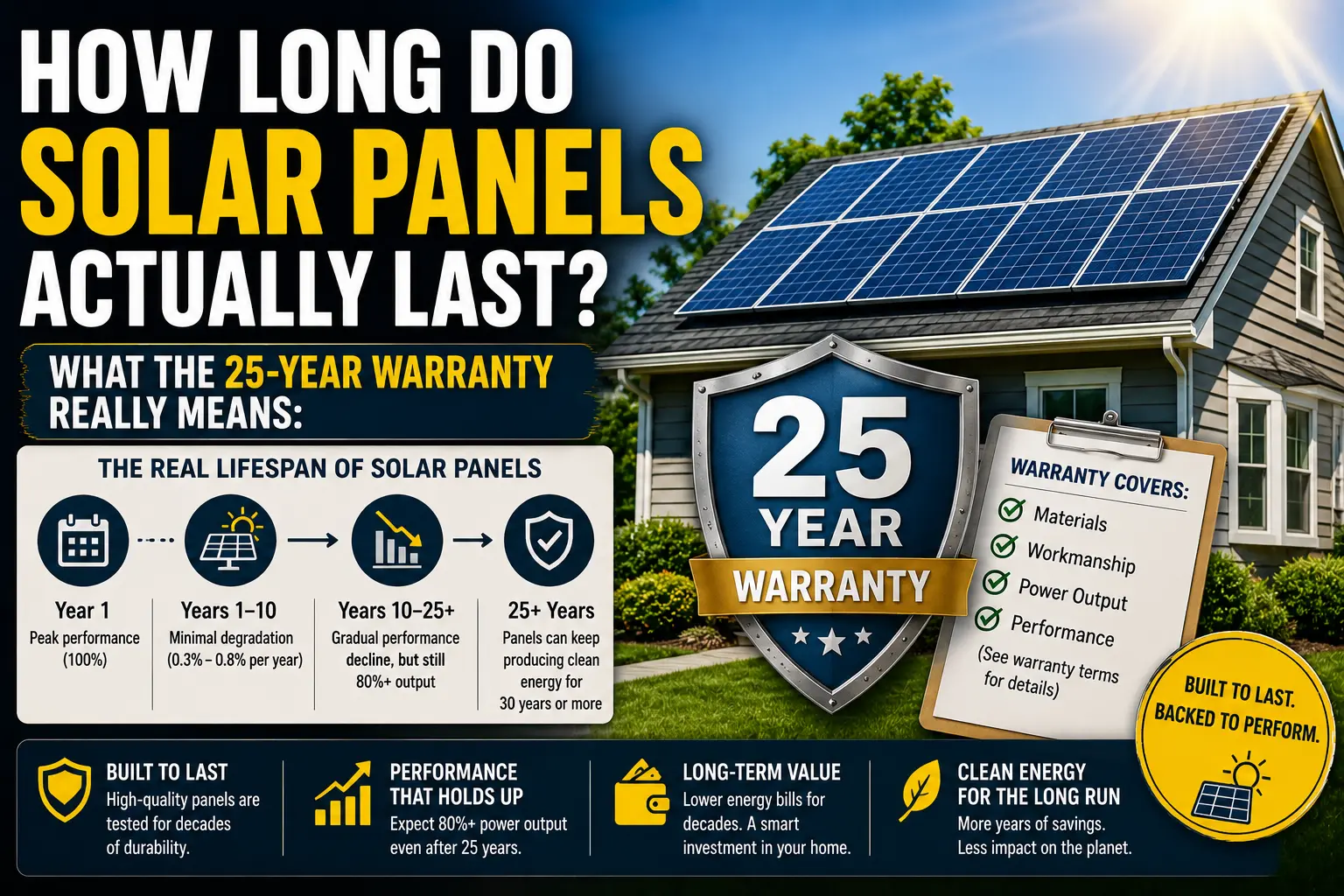
The industry standard degradation rate is approximately 0.5% per year. At that rate, panels at year 25 are producing about 87.5% of their original output. For a 9.6kW system, that means ~8.4kW effective capacity at the end of the warranty period. Still generating meaningful savings.
But that 0.5% is an average — and averages hide the range. Budget panels from manufacturers with thinner margins on quality control can degrade at 0.7–0.9% per year. Premium panels like SunPower Maxeon are warranted to degrade no more than 0.25% per year. At that rate, year 25 output is 93.75% of original — a meaningful difference over a 25-year period when you’re doing the financial math.
According to NREL’s degradation rate research, which analyzed data from over 2,000 solar installations, the median degradation rate across all panel types was 0.5%/year — but the distribution was wide. Quality of manufacturing and installation conditions both matter significantly.
What the 25-Year Warranty Actually Covers (And What It Doesn’t)
This is where most homeowners get surprised.
A standard solar panel warranty has two separate components that often get blurred together in sales pitches:
Product warranty — covers defects in manufacturing. A panel that cracks, delaminates, or has a junction box failure within the warranty period. Most manufacturers offer 10–12 years on product; premium manufacturers like SunPower, Panasonic, and REC offer 25 years. This is the warranty that protects you from a defective unit.
Performance warranty — guarantees minimum output level at specified points in time. A typical performance warranty reads something like: “panels will produce at least 80% of rated power after 25 years.” SunPower’s Maxeon warranty guarantees 92% at year 25. That difference — 80% vs. 92% — is roughly 1.2kW of capacity on my system. At Austin Energy’s current rates, that’s about $200–$250 per year in savings difference in the final years of the warranty.
What warranties almost never cover: inverter failure, wiring issues, racking corrosion, or anything caused by your roof substrate. These are the components that actually fail more frequently than panels themselves, and they’re covered under separate warranties from separate manufacturers.
When I was comparing quotes, the red flags I documented included exactly this — the fragmented warranty structure that leaves homeowners exposed when a problem doesn’t fit neatly into “panel defect” or “installation error.” Worth reading before you sign anything.
What Actually Fails First
In my two-plus years of monitoring and from conversations with Marcus, here’s the real degradation risk hierarchy:
Inverters — the most common failure point in a solar system. String inverters typically carry 10–12 year warranties. Microinverters (Enphase IQ series) carry 25 years. My system uses Enphase IQ8 microinverters, which was part of my reasoning for the premium — I didn’t want to budget for a string inverter replacement at year 12.
Replacement cost for a string inverter at year 12: typically $2,000–$4,000 installed. A cost most homeowners don’t factor into their initial payback calculation.
Racking and mounting hardware — rooftop equipment exposed to weather, UV, and thermal cycling. Quality aluminum racking from reputable manufacturers (IronRidge, Unirac) lasts 25+ years. Budget racking can corrode in 10–15 years in coastal or high-humidity climates.
Junction boxes and wiring — typically the weak point in budget panels. Water ingress into a junction box causes cell-level failure. This is covered under product warranty if caught within the warranty period — but diagnosing which panel is failing and processing a warranty claim takes time.
The panels themselves — genuinely the most durable component. Dave’s Sunrun system uses a different panel brand than mine, and his one underperforming panel turned out to be a junction box issue, not a cell degradation problem. Covered under warranty, replaced in about 8 weeks.
What 25-Year Performance Actually Looks Like in Real Money
Let me run this on my system specifically.
My system at year 1: 9.6kW, produced 14,312 kWh, saved approximately $1,860 (Austin Energy blended rate).
My system at year 25 (SunPower’s guaranteed 92% output): ~8.8kW effective, estimated 13,167 kWh production, savings at today’s rate approximately $1,711. But electricity rates won’t be the same in 2047 — if rates rise at 2% annually (conservative estimate), my year 25 rate is ~$0.21/kWh, making that same production worth ~$2,765 in savings.
The financial case actually improves over time as electricity rates rise, even as panel output gradually declines. The two curves work in your favor.
According to Lawrence Berkeley National Laboratory’s solar value research, homes with owned solar systems sell for a premium averaging $15,000–$20,000 above comparable non-solar homes — based on the remaining useful life of the system at time of sale. A 5-year-old system selling with 20 years of warranty left commands a higher premium than a 15-year-old system with 10 years remaining. Timing of sale matters.
How to Actually Monitor Your System’s Performance
If you’re not monitoring your system’s output actively, you’re flying blind on degradation.
Every major inverter manufacturer has a monitoring app: Enphase Enlighten, SolarEdge monitoring, Tesla app for Powerwall-connected systems. They show daily, monthly, and annual production. The one I use (Enphase Enlighten) lets me see output per individual panel — so if a single panel underperforms, I can catch it before it becomes a warranty claim that’s out of date.
What to watch for:
- Any single panel producing more than 10% below its neighbors (same orientation, same shade conditions) — potential cell or junction box issue
- Seasonal production below NREL’s PVWatts estimate for your location by more than 8–10% — shading change, soiling, or early degradation
- Year-over-year production declining faster than 0.5–0.7% — warrants a service call
Most homeowners never log into their monitoring app after the first few months. That’s fine — the system works whether you watch it or not. But if you want to catch warranty-eligible issues while they’re still in warranty, active monitoring is the only way.
The Real Lifespan Question
Will your panels still be working in 30 years? Probably. Research on early commercial installations from the 1990s shows many panels still producing at 70–75% of original output after 30+ years — well beyond their warranted life.
The more relevant question is: will they be worth keeping in 30 years? Panel efficiency has improved dramatically over the past decade. In 2025, replacing a 2022 system with then-current technology in 2037 might yield meaningfully higher output from the same roof space — potentially worth the cost of upgrade if panel prices continue their historical decline.
That’s a future decision, not a current one. For now, the 25-year warranty is real, the degradation is manageable, and the financial case I ran before buying assumed conservative degradation and still showed a strong positive return.
The panels will outlast the payback period. That’s the only thing that actually matters.
— Allen
