

The rep who came to my house in September 2021 opened with the lease pitch.
“No money down. Your payment will be lower than your current electric bill. We handle all the maintenance.” He had a laminated one-pager. It looked clean. I almost stopped listening after “no money down” because I was already sold.
Then I asked one question: “Who owns the panels?”
The answer — “the leasing company does, for 20 to 25 years” — changed the entire conversation. What followed was 45 minutes of me asking questions the rep clearly wasn’t used to being asked. I didn’t sign that day. I went home, ran the numbers on both options, and talked to Marcus, who’d seen hundreds of these contracts from the installer side.
Here’s what I found.
The Core Difference
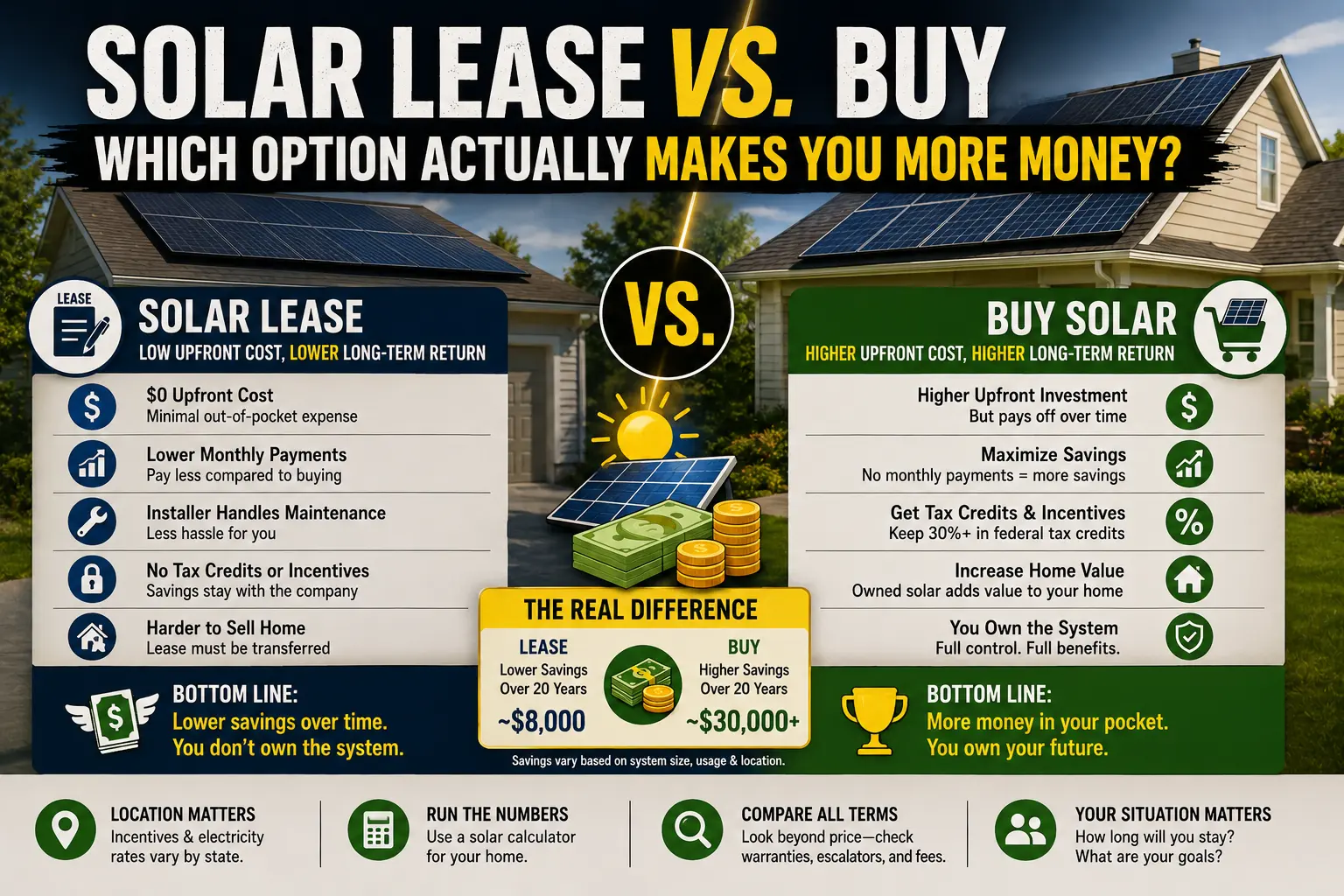
When you buy solar — whether cash or a loan — you own the system. You claim the 30% federal tax credit. The panels add value to your home. When you sell the house, the system conveys to the buyer.
When you lease solar, a third-party company owns the panels on your roof. You pay a monthly fee to use the power they generate. The company claims the tax credit. The panels are their asset, not yours. The lease runs 20–25 years and includes an escalator clause — typically 1–3% annual payment increases.
That escalator is the detail most people gloss over. At 2% annual escalation, your monthly lease payment in year 20 is 49% higher than in year 1. If rates don’t rise as fast as the escalator, you’re eventually paying more for solar than you would have for grid power.
The 25-Year Math, Side by Side
Let’s use real numbers based on a system similar to mine — a 9.6kW install in a market with average electricity rates.
Purchase (cash):
– System cost: $28,400
– Federal tax credit (30%): –$8,520
– Net cost: $19,880
– Annual electricity savings (at $0.13/kWh): ~$3,200
– Payback period: ~6.2 years
– Total savings over 25 years (after recouping cost): ~$60,120
– Home equity gained: estimated $15,000–$20,000 in resale value per Lawrence Berkeley National Laboratory research
Lease (typical structure):
– Monthly payment: $120–$160 (zero down)
– Annual escalator: 2%
– Year 1 annual cost: $1,680
– Year 25 annual cost: ~$2,748
– Total lease payments over 25 years: ~$52,000
– Tax credit: goes to the leasing company
– Home equity gained: $0 (you don’t own the asset)
– Complication at home sale: lease must be transferred to buyer or bought out
Net position at year 25:
– Purchaser: ahead by roughly $60,000 and owns a paid-off asset
– Lessee: has paid $52,000 in lease fees with nothing to show for it
The math isn’t close. Over 25 years, buying wins by a wide margin for anyone who can handle the upfront cost — even financed.
Where Leasing Makes Sense Anyway
I want to be honest here, because I’ve seen this comparison done lazily. Leasing isn’t always the wrong answer. There are specific situations where it’s the rational choice.
If your federal tax liability is too low to use the credit. The 30% IRA credit only applies to the tax you owe. If you’re retired with modest income, or have significant deductions that reduce your liability, you may not be able to use most of the credit. The leasing company uses it instead. You trade the credit for simplicity. That’s a real tradeoff worth calculating.
If you genuinely can’t qualify for a solar loan and don’t have the cash. A lease puts panels on your roof with no credit hurdles. You’ll overpay over 25 years compared to buying, but you’ll start saving on electricity immediately and pay nothing upfront.
If you’re planning to move within 5 years. Leases complicate home sales — the buyer has to assume the lease or you have to buy it out, which can run $10,000–$20,000 depending on remaining term. But if you’re moving in 2–3 years, the purchase payback period hasn’t even started yet either. Neither option is great for short-horizon homeowners. The lease may be less painful to exit than carrying an asset you haven’t yet recouped.
Marcus told me he’s seen lease complications kill home sales. “The buyer’s lender won’t approve the loan with the lease on the property, and the seller doesn’t have the buyout money. Deal falls apart.” It happens more than the solar industry likes to admit.
The Loan Is Not the Same as a Lease
Financing a solar purchase with a loan is fundamentally different from leasing — and the two get confused constantly.
With a solar loan, you own the system. You claim the tax credit. You build equity. The loan is a liability; the panels are your asset. When the loan is paid off, your savings are free and clear.
With a lease, you own nothing. You have a contractual obligation to pay monthly fees for 20–25 years.
The confusion is understandable because both involve monthly payments. The difference is what you own at the end: with a loan, a paid-off system. With a lease, nothing.
I covered the loan math in detail in my post breaking down what solar actually costs after the tax credit — including the total interest calculation that most financing pitches leave out. The short version: a well-structured solar loan at a reasonable APR still beats a lease by a significant margin over the system’s life.
The Home Sale Problem, In Detail
This is the biggest practical risk with a lease that doesn’t get enough attention.
When you sell a home with leased panels, you have three options: transfer the lease to the buyer (requires buyer qualification and approval from the leasing company), buy out the lease yourself (can be $10,000–$25,000 depending on remaining term and contract), or have the leasing company remove the panels (which they may or may not do at no charge depending on your contract).
None of these is simple. All of them introduce friction into a home sale at exactly the moment when you want no friction.
Dave’s neighbor down the street — not Dave, someone else on the block — had this problem in 2023. Listed her house with 14 years left on a SunRun lease. Took two months longer to close than expected because the buyer’s lender needed the lease subordination agreement and SunRun’s legal team was slow. She eventually closed, but she told Dave the whole situation added significant stress she hadn’t anticipated when she signed the lease eight years earlier.
SEIA’s consumer guide on solar leases touches on the home sale disclosure requirements that vary by state — worth reading if you’re leaning toward a lease and plan to sell within 10 years.
My Verdict
Buy if you can, finance if you need to, lease only if you can’t qualify for financing or have a specific tax situation that makes the credit useless to you.
The lease exists because it works well for the leasing company. They get a 30% tax credit on a system they place on your roof, lock in 20–25 years of revenue with an escalator clause, and market it to you as a convenience. It’s a smart business model. It’s not as good for the homeowner as owning.
Before I signed anything, I read the red flags I documented after going through this process myself — the lease structure was flag number five in that post, specifically the opacity around total payments over the contract life. If you’re comparing options right now, that post is worth reading alongside this one.
The rep with the laminated one-pager was a good salesperson. The pitch was compelling. The math just didn’t hold up once I ran it.
— Allen
