
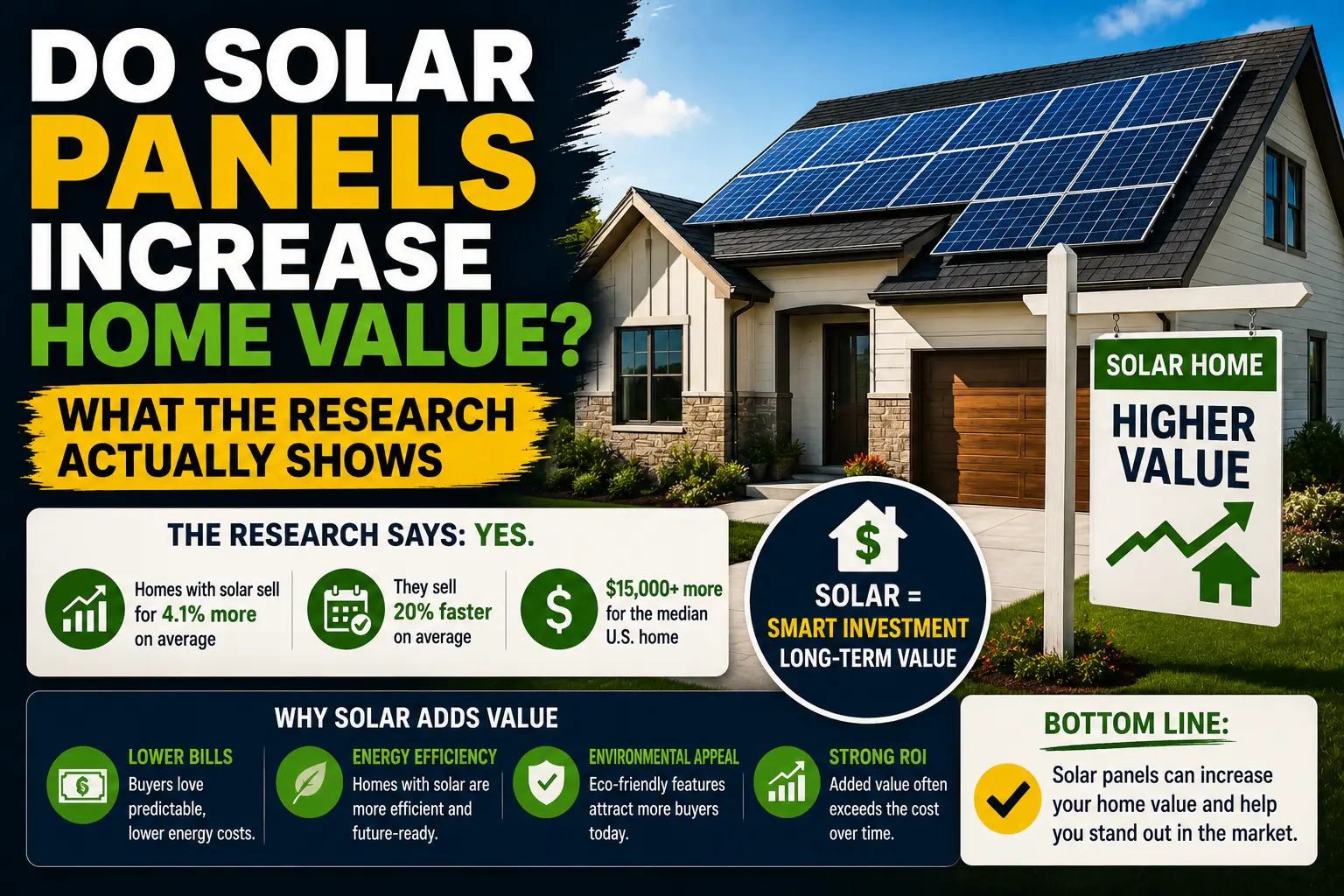

$15,000. That’s the average home value premium that Lawrence Berkeley National Laboratory found for a solar-equipped home in a widely cited analysis of 22,000 home sales across eight states.
That number — from what’s still the most rigorous independent study on this question — has been cited constantly since it was published. What gets cited less often: it came from a 2015 dataset, represents a national average that varies enormously by state, applies only to owned systems, and is based on a median system size smaller than what most homeowners install today.
The real answer to “do solar panels increase home value?” is yes — but the amount depends on where you live, what kind of system you have, and whether your appraiser knows how to value it. That last part is the one that actually trips people up at closing.
What the Research Actually Found
The Lawrence Berkeley Lab study, updated in subsequent years by researchers at LBNL and now cited in their ongoing solar home value research, found that solar panels add approximately $4 per watt of installed capacity to home sale price, on average across US markets. For a 9.6kW system like mine, that formula implies roughly $38,400 in added value — though that figure is for premium systems in premium markets and shouldn’t be taken as a national guarantee.
A more conservative and widely applicable figure: 3–4% of home sale price as the solar premium, based on Zillow’s analysis of actual home transactions. On a $450,000 home, that’s $13,500–$18,000. On a $650,000 home, $19,500–$26,000.
The premium is real. The variation is also real.
States where the premium is strongest: California (highest premium nationally — solar is expected by buyers), New Jersey, Massachusetts, New York, and Colorado. These are markets where buyers understand solar, utility rates make the savings visible, and the solar lifestyle is embedded in home-buying expectations.
States where the premium is more modest: Texas, Florida, much of the Southeast and Midwest. Solar is less common, buyers are less educated about it, and appraisers are less experienced valuing it. My Austin home almost certainly has some solar premium — but I’d estimate it’s lower than the LBNL average, not higher.
The Appraiser Problem (And Why It Matters at Closing)
Here is where the theory meets an uncomfortable reality.
The solar premium only materializes if the appraiser handling your home sale knows how to value solar correctly. Many don’t. Residential appraisers use comparable sales to set home values — and in markets where solar is still uncommon, there may not be enough solar-equipped comps to establish a reliable premium. When appraisers can’t find comparable data, solar often gets valued at $0 or close to it.
This has happened to homeowners I’ve heard about through Marcus’s network. A homeowner in a Dallas suburb installed a $28,000 solar system, got a cash offer that reflected the solar value, then saw the appraisal come in with essentially no solar premium — which torpedoed the buyer’s financing because the home didn’t appraise at the agreed price.
The right valuation method for solar is called the income approach — calculating the present value of future electricity savings the system will generate over its remaining useful life. The PV Value tool, developed specifically for solar appraisal, walks through this calculation. Fannie Mae and Freddie Mac both have guidelines that allow this methodology; the problem is that not every appraiser has been trained to apply it.
What to do if you’re selling a solar home: Ask your real estate agent to specifically seek out appraisers with solar valuation experience. Provide documentation: your system’s monitoring data, annual production history, equipment specs and warranty terms, and remaining warranty period. The more you help the appraiser make the income approach calculation, the better your chances of the premium showing up in the appraisal.
Owned vs. Leased: Night and Day Difference
This is where the value question diverges sharply — and why the lease vs. buy decision has implications that extend well beyond the monthly payment comparison.
Owned solar adds value. It’s an asset that conveys with the home. The buyer gets the panels, the warranty, and the future electricity savings. Appraisers can value this using the income approach. Buyers understand they’re acquiring something with economic benefit.
Leased solar complicates the sale. It doesn’t add value in the traditional sense because you don’t own it — the leasing company does. The buyer has to assume the lease (subject to the leasing company’s approval and the buyer’s qualification) or you have to buy it out before closing. Some buyers simply won’t touch a home with a lease in place. Others will offer less, anticipating the friction of the assumption process.
In practice, leased solar in states with less solar-aware buyers — parts of Texas, most of the Southeast, the Midwest — is more likely to create sale complications than leased solar in California, where buyers are more familiar with lease transfers. This is one of the real-world costs of leasing that doesn’t appear in the monthly payment comparison at signing time.
The premium from a 9.6kW system like mine — if everything goes smoothly at appraisal — likely adds $15,000–$25,000 to my home’s eventual sale price. None of that would exist if I’d leased. That delta is part of the full financial case for buying rather than leasing that gets underweighted when people focus only on the monthly payment comparison.
How System Age Affects the Premium
Solar panels don’t add value at a flat rate forever. The premium reflects the remaining useful life of the system — specifically, how many years of savings the buyer can expect to receive.
A brand-new system with a 25-year performance warranty commands the highest premium. A 10-year-old system with 15 years remaining commands a proportionally lower one. A 20-year-old system with 5 years left on the warranty and unknown degradation history commands very little premium — and may actually raise buyer concerns about imminent replacement costs.
This has a practical implication for timing: if you plan to sell within 3–4 years of install, the system is nearly new and the premium should be near-maximum. If you plan to sell at year 18 or 19, the premium has declined significantly and may not recoup much of what you spent.
Claire asked me early on whether the solar would “hurt us when we sell.” I told her it wouldn’t — which is true, as long as we’re selling within the next 15–18 years. After that, the calculus changes. We don’t intend to move anytime soon, and by the time the warranty runs thin, the panels will have long since paid for themselves in electricity savings. The resale premium is a bonus, not the thesis.
What Actually Shows Up on the MLS Listing
In most markets, solar listings perform measurably better than non-solar equivalents. Zillow’s research found that solar homes sold 18.9% faster on average than comparable non-solar homes, in addition to the price premium. Buyers who are actively looking for solar features — and they exist, especially among buyers in their 30s–50s who are tracking energy costs and climate factors — will prioritize a solar home when all else is equal.
The listing language matters. Vague mentions of “solar panels” are less effective than specific data: “9.6kW SunPower system, installed 2022, 25-year warranty, avg electricity bill $22/month, annual savings ~$3,200.” Specific numbers tell the buyer exactly what they’re getting. They also help the appraiser.
Your monitoring app is the source for this. My Enphase Enlighten data gives me annual production by year, monthly averages, and system health history. Two years of that data in a listing packet is a credible, verifiable asset that generic “solar home” marketing is not.
The Bottom Line
Yes, solar panels increase home value — credibly, measurably, and by enough to factor into the purchase decision. The $15,000–$20,000 premium range is realistic for most US markets with owned systems in good condition and an informed appraisal process.
The caveats: market matters, appraiser competence matters, system age matters, and whether you own or lease matters completely. Leased systems don’t add value and frequently create friction. An owned system with documented production history, in a market with experienced appraisers, adds value that shows up in your sale price and closes faster.
I don’t think of my solar system as a home improvement in the kitchen-backsplash sense. It’s a financial asset — one that pays me annually in electricity savings and will return something at the end when I sell. The economics I ran before buying didn’t assume a resale premium at all. Anything the sale generates from the solar premium is upside I didn’t build the decision around.
That’s the right way to think about it. The primary case is in the electricity savings. The home value increase is a secondary benefit — real, but not something to bet your payback math on.
— Allen
