
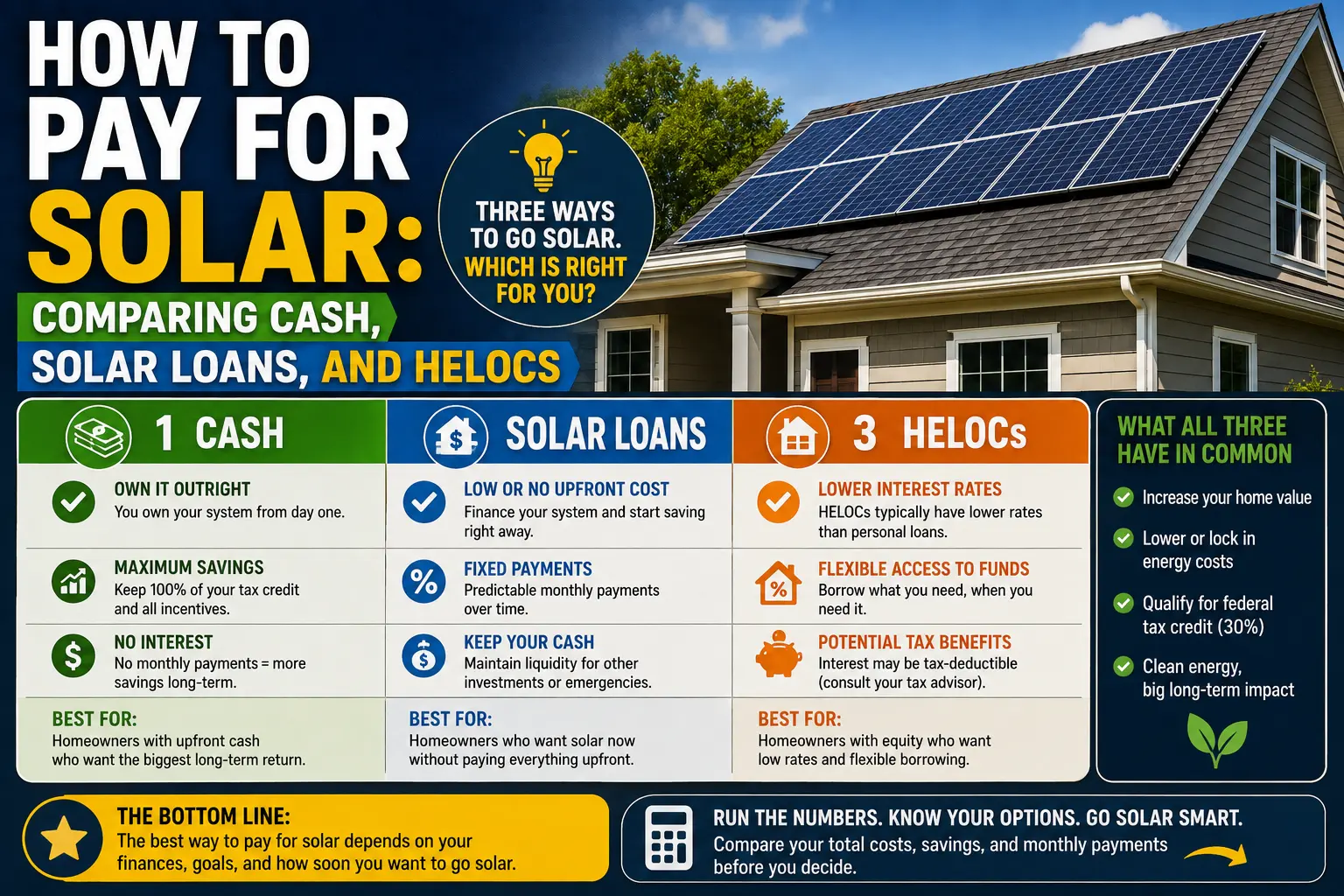

The financing conversation is where most solar sales pitches get deliberately blurry.
Installers love to present solar as a simple swap — “replace your electric bill with a solar payment” — without being precise about what that payment actually includes, how long it lasts, or what the system ends up costing when you run the interest out to maturity. I sat through four pitches that led with monthly payment comparisons before any installer gave me a total cost of ownership number.
I paid cash for my system. That was the right choice for my situation, but it isn’t the right choice for everyone, and it isn’t the only path to good solar economics. Here’s what I found when I compared every realistic option — and the one financing trap that catches a significant number of buyers off guard.
The Baseline: What the System Actually Costs
Before any financing comparison is useful, you need a clean cash price to anchor everything else to. This sounds obvious. In practice, many homeowners go through the entire financing process without ever knowing their system’s actual cash value because the installer quoted only a monthly payment.
Require the cash price in writing before you evaluate any financing option. It’s the only way to calculate what interest is actually costing you, and whether the installer has inflated the system price to offset a dealer fee (more on that shortly).
My system: 22 SunPower Maxeon 3 panels, 9.6kW, Enphase IQ8 microinverters, full permit and install in Austin, TX. Cash price: $28,210. After the 30% federal tax credit (ITC) applied to my following year tax return: net cost $19,747.
I walked through the full breakdown in my earlier post on what solar actually costs in 2025. Those numbers are the foundation for everything that follows here.
Option 1: Cash
How it works: You pay the full system price upfront. The ITC credit comes back to you as a federal tax refund (or reduced tax liability) the following spring.
The real upfront cost: Full cash price minus any immediate state/local rebates. The federal ITC doesn’t reduce the upfront cash outlay — it reduces your tax bill in the next filing year. You need to have the full cash price available, then you receive the credit back later.
Total cost of ownership: The lowest of any financing option because you pay zero interest. Every dollar of savings the system generates is pure return — no debt service eating into it.
Annual return (my system):
- Annual electricity savings: ~$3,230 (house + Bolt EV)
- Annual interest cost: $0
- Net annual return: $3,230
- Simple payback on net cash cost of $19,747: ~6.1 years
After payback, the remaining ~18 years of system life is essentially all return. That’s a compelling long-term math problem.
Who this works for: Homeowners with sufficient liquid assets who don’t have higher-return uses for that capital. If you have a 7% investment portfolio and a solar system offering 6% returns, the math slightly favors keeping investments and financing solar at a competitive rate. If you’re sitting on cash earning 4.5% in a savings account and the solar system offers 6%+, paying cash is straightforward.
The honest downside: Liquidity. $19,747 net (or $28,210 gross, waiting for the ITC) is a real sum. Concentrating that much capital in an illiquid home improvement has a legitimate opportunity cost that varies by person.
Option 2: Solar Loans
How it works: A lender (usually a solar-specific lender like Mosaic, Sunlight Financial, or GoodLeap, or a regional bank) finances the system purchase. You own the system, qualify for the ITC, and make monthly payments over a fixed term.
Typical terms: 10–25 year loan terms. Rates in 2024–2025 have ranged from 5.99% to 9.99% APR for well-qualified borrowers, with some lenders pushing 10–14% for shorter approval processes.
The dealer fee problem — and why it matters: This is the trap I mentioned upfront, and it’s significant enough to spend real time on.
Solar lenders charge installers a “dealer fee” — typically 20–35% of the loan amount — for access to their lending platform and quick approvals. Many installers pass this fee to the consumer by inflating the financed price. Your cash quote might be $28,000. Your financed quote from the same installer, through their preferred lender, might be $34,000 — presented as a “financed price” without transparency about why it’s higher.
Dave ran into exactly this. His Sunrun quote had a cash price and a “solar loan” price that were different by $5,400. When he asked why, the rep said it was because “the lender has fees.” He didn’t push further. Over 20 years at 7.99%, that $5,400 difference compounds to roughly $11,600 in additional total payments.
What to do: Always get the cash price first. If the installer offers a financed price higher than the cash price, ask them to explain the difference line by line. Legitimate financing costs (document fees, etc.) should be disclosed separately. A systemically inflated price is a red flag.
ITC handling with a solar loan: The 30% ITC still applies — you own the system. The smart move is to apply your full ITC refund as a lump-sum principal payment in year one. If you don’t, you’re paying interest on the full pre-ITC loan balance for the entire term, which is a significant extra cost.
Example (my system, hypothetically financed):
- Loan amount: $28,210
- ITC credit (year 1): $8,463
- Remaining balance after ITC payment: $19,747
- 15-year term at 7.5% APR: ~$183/month ($32,940 total — about $13,193 in interest)
- vs. my cash purchase total cost: $19,747
That $13,193 in interest is real money. It extends payback from 6.1 years (cash) to roughly 9–10 years (loan), and it reduces lifetime return on investment meaningfully. A loan isn’t a disaster — it’s a reasonable tradeoff for homeowners who don’t want to deploy $28K in cash — but you should know what you’re actually trading.
Who this works for: Homeowners who want to own their system (vs. lease) but don’t have — or don’t want to use — the full cash amount. The math still beats grid electricity in most cases, just by a smaller margin than cash.
Option 3: HELOC (Home Equity Line of Credit)
How it works: You borrow against your home equity at your bank or credit union. HELOCs are typically variable-rate, though some lenders offer fixed-rate options. You draw the amount needed, pay interest on the balance, and repay on your own schedule or within the draw/repayment period.
Why this is often the best financed option:
- Rates are generally lower than solar-specific loans — in 2024, HELOC rates ranged from 6.5% to 8.5% for well-qualified borrowers, vs. 7.5%–9.99% for many solar loans
- No dealer fee inflation — the HELOC is between you and your bank, not routed through the installer’s preferred lender
- Interest on HELOCs used for home improvements is tax-deductible if you itemize (consult your tax advisor; the deduction applies when the funds improve the home)
- You control the repayment schedule, which allows you to make a large payment immediately with the ITC refund without a prepayment penalty
The real downside: Your home is collateral. A solar loan is an unsecured or system-secured debt in most cases — defaulting is bad but doesn’t directly threaten your home. A HELOC puts your equity at risk if payments lapse. For most homeowners with stable incomes, this is a manageable risk. It’s not a risk to ignore.
You also need equity. A HELOC requires sufficient home equity — typically 15–20% equity remaining after the draw. If your home is relatively new or highly mortgaged, this option may not be available.
Example (my system, hypothetically via HELOC):
- HELOC draw: $28,210
- ITC credit applied immediately in year 1: $8,463
- Remaining balance: $19,747
- At 7.0% over 10 years: ~$229/month ($27,480 total, ~$7,733 in interest)
- Better than most solar loans on rate and total cost — assuming no dealer fee inflation
Who this works for: Homeowners with meaningful equity, stable income, and an existing banking relationship that allows competitive HELOC terms. If you can get a HELOC at 6.5%–7.5% with no application complications, it’s often the most cost-efficient financed path.
Option 4: Home Equity Loan (HEL)
Briefly — a home equity loan is the fixed-rate, lump-sum cousin of the HELOC. Same equity requirement, same collateral risk, but a fixed rate and fixed payment schedule. Rates are typically slightly higher than HELOC variable rates in a normal rate environment. For homeowners who want predictability and rate certainty, it’s worth getting a quote alongside the HELOC comparison.
The Option I’d Avoid: Unsecured Personal Loans
Personal loans for solar typically run 10–18% APR for terms of 3–7 years. The math doesn’t work well — you’re paying premium interest rates on an asset that returns 5–8% annually. It can make sense in very specific situations (short term, small system, high credit score getting a competitive offer), but as a general path, it’s the weakest option in the solar financing lineup.
The Lease and PPA Alternative — And Why I Didn’t Take It
This is worth a brief mention because it comes up in every sales conversation. Leases and power purchase agreements (PPAs) are not financing — they’re rental arrangements where you don’t own the system, don’t get the ITC, and don’t build equity in the equipment.
I covered the full comparison in my post on leasing vs. buying solar. Short version: leases make sense for people who can’t use the ITC (insufficient tax liability) or genuinely can’t access any other financing. For everyone else, ownership through cash, HELOC, or a well-structured solar loan produces better long-term outcomes.
The Decision Framework
Answer these questions in order:
1. Do you have the cash and would it otherwise sit in low-yield savings? → Pay cash. Best long-term outcome.
2. Do you have significant home equity and can access a competitive HELOC? → HELOC first. Compare rate against solar loan offers.
3. Does the installer’s financed quote match the cash quote (no dealer fee markup)? → Solar loan is reasonable. If there’s markup, negotiate or find a lender independently.
4. None of the above? → Personal loan is expensive. Revisit whether timing and system size make sense, or wait until equity or savings improve.
Whatever path you take: get the ITC refund amount into a plan before you sign. Knowing you have a $6,000–$10,000 credit coming back in year one changes the cash flow picture significantly, and it should factor into which financing structure you choose.
— Allen
