
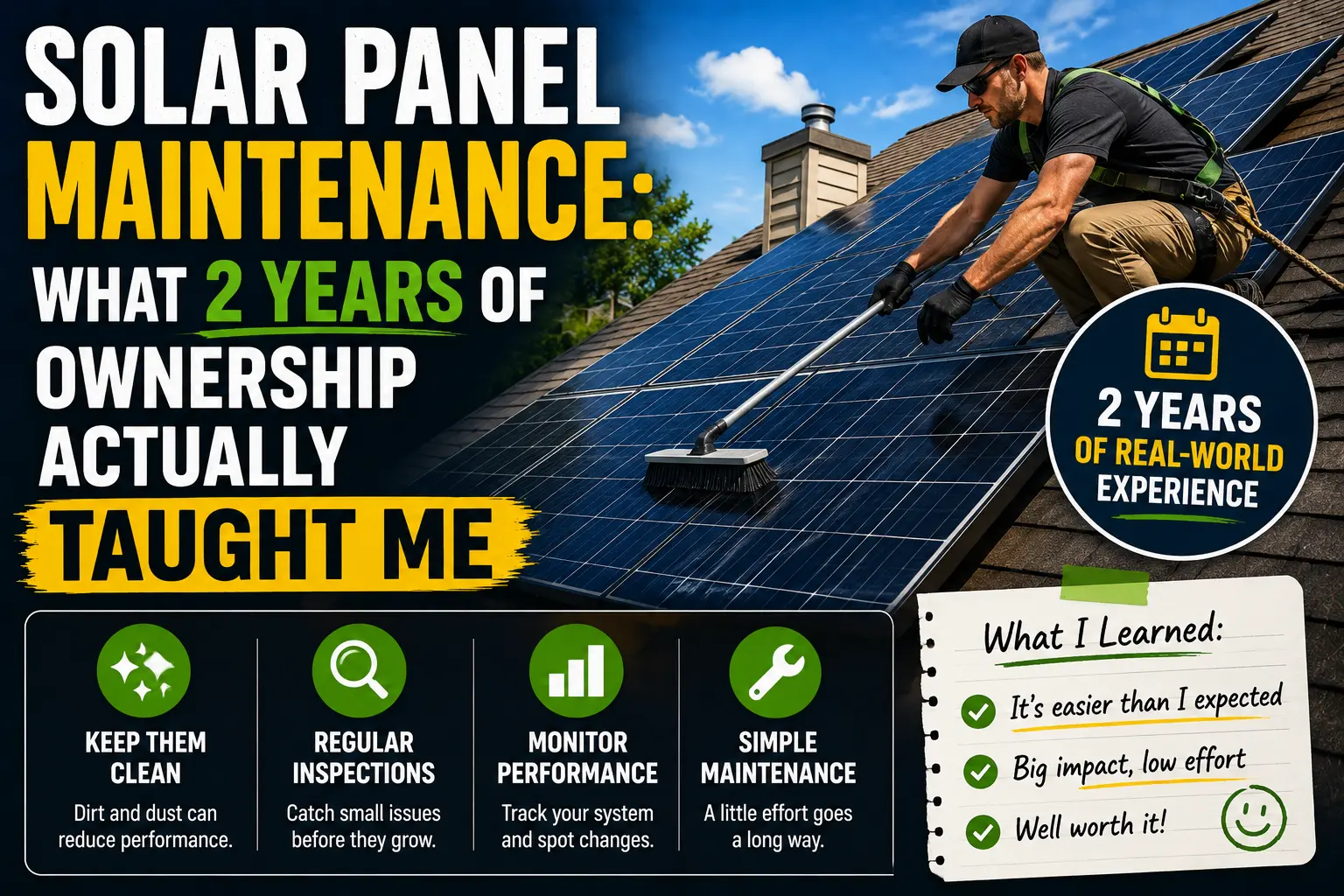

Dave knocked on my door last April holding a garden hose and a telescoping squeegee.
“I’m going up to clean my panels this weekend,” he said. “Want me to do yours too while I’m at it?”
I told him I appreciated the offer but I’d pass. He looked genuinely puzzled. “You never clean yours?”
The honest answer: in two full years of ownership, I have cleaned my panels exactly once — a light rinse with a garden hose after a particularly bad pollen week in March 2024 when I noticed a 4% production dip that corresponded with yellow-green pollen coating on the south-facing section. That’s it. No squeegee, no soap, no professional cleaning service, no ladder.
Dave cleaned his panels four times last year. I’m not sure it moved the needle on his production numbers in any measurable way.
Here’s what two years of actual ownership taught me about solar panel maintenance — including the one thing that does matter and the several things that mostly don’t.
The Self-Cleaning Reality
Modern solar panels are designed to be largely self-maintaining. The glass surface is smooth and slightly hydrophobic — rain water sheets off rather than pooling, carrying most accumulated dust and pollen with it. In climates with regular rainfall, panels stay reasonably clean without any intervention.
Austin gets about 34 inches of rain per year, distributed across the calendar. That’s enough rainfall frequency that my panels see a natural rinse every couple of weeks during most of the year. Monitoring data confirms it: my production numbers track closely to expected output based on solar irradiance, with no sustained dip that I’d attribute to soiling.
The research backs this up. Studies on residential panel soiling consistently find that in climates with moderate rainfall, manual cleaning recovers 1–3% of production at most — and in many cases less than 1%. Paying a cleaning service $150–$300 per visit to recover 1% of a $3,200/year production value ($32) is not a sound financial calculation.
Where cleaning does matter: Arid climates with infrequent rain — Phoenix, Las Vegas, much of inland California — see meaningful dust accumulation. Studies in these environments show soiling losses of 5–7% without periodic cleaning. If you’re in the desert Southwest and haven’t had meaningful rain in 6–8 weeks, a rinse with a garden hose from ground level (if safely reachable) is worth doing.
Bird droppings are the other exception. Unlike uniform dust, which the panel can partially work around, a concentrated dropping on one section of a panel blocks all light to that area and disproportionately reduces output. If you’re monitoring per-panel production (one of the reasons I chose microinverters over a string inverter), you’ll see a specific panel underperforming when it has a significant spot obstruction. That’s worth addressing.
What Maintenance Actually Looks Like Year to Year
The honest answer: for most homeowners in most climates, “solar panel maintenance” is mostly just monitoring. Here’s my actual annual routine.
Monthly (5 minutes): Check the Enphase Enlighten app. I’m looking for any panel that’s underperforming relative to its neighbors in similar positions. A panel producing 80% of what adjacent identical panels are producing is a flag. A panel producing 50% is an immediate flag. A panel showing offline is a call to SunPower.
This monitoring habit is what caught the one real issue I’ve had in two years. In month 14, one of my 22 microinverters started reporting production about 23% below its neighbors on the same roof section. No obvious explanation from visual inspection. I logged a warranty claim with SunPower, they reviewed the monitoring data remotely, confirmed the microinverter was degraded, and sent a replacement. The installer swapped it in under warranty. Total cost to me: $0. Time spent: maybe 20 minutes over two weeks of back-and-forth.
Without per-panel monitoring, I would not have caught this. The whole-system production number was only 1% lower than expected — easy to miss against normal day-to-day variation in solar irradiance. The microinverter would have continued underperforming for potentially years before showing up as a noticeable system-level issue. This is one of the real-world maintenance arguments for per-panel monitoring that I talked about in my longevity post.
Seasonally (15 minutes, twice a year): A visual check from ground level. I’m looking for:
- Visible physical damage — cracked glass, broken frame corners, anything that looks structurally compromised
- Debris accumulation — leaves, branches, anything lodged between panels or on the mounting rails
- Shading changes — has the oak in my neighbor’s yard grown enough this season to throw new shade on my east section? (It’s getting close.)
- Inverter status lights — a quick look at the Enphase gateway unit on my garage wall to confirm all lights are as expected
Annually (30 minutes, or a professional inspection every 2–3 years): A more deliberate check of the mounting hardware and wiring from the roof edge if you’re comfortable going up, or a professional inspection if not.
What I’m looking for in the annual check:
- Mounting rails still secure — no visible loosening at the roof penetration points
- Wire management — conduit intact, no exposed wiring that might have been disturbed by wildlife or weather
- Flashing around any roof penetrations — no visible cracking or lifting that could allow water intrusion
- Panel surface — up-close look for microcracks, delamination, or discoloration that ground-level inspection can’t show
I’ve done this once myself and plan to bring in a licensed roofer for a combined roof-and-solar-mount inspection at the 5-year mark. Marcus told me this is standard practice among the installers he knows — not because anything typically fails at 5 years, but because catching a loose mounting screw or minor flashing issue at 5 years costs $200; catching it at 12 years after water has gotten in costs significantly more.
What Voids Your Warranty (And What Doesn’t)
SunPower’s Maxeon warranty is comprehensive, but like any warranty it has conditions. The things that can void or complicate warranty claims:
Physical damage from improper cleaning: Pressure washers, abrasive pads, and harsh cleaning chemicals can scratch the glass surface or damage the anti-reflective coating. If you or a cleaning service causes this damage, it’s not a warranty claim. A garden hose at low pressure, plain water, and a soft brush if needed — that’s the safe cleaning method. Anything more aggressive is a risk to the warranty.
Unauthorized modifications or additions: Adding shading structures that weren’t accounted for in the original install, attaching anything to the panels or racking, or making electrical modifications to the system yourself are all potential warranty complications. Any changes to the system should go through your installer.
Installer-caused issues: If your original installation caused a problem that surfaces later — poor flashing, undersized wiring, improper grounding — that’s on the installer, not the manufacturer. This is one reason installer selection matters as much as panel brand. I covered the installer red flags worth watching for in my early post on what I learned the hard way before buying.
Normal wear: Panel degradation within the warranty’s guaranteed rate (SunPower guarantees no more than 0.25% degradation per year) is covered. You won’t need to prove this yourself — the monitoring data does it for you.
The Professional Maintenance Services: Worth It?
Some solar installers offer annual maintenance contracts — typically $150–$300/year — that include a site visit, cleaning, inspection, and system check. Are they worth it?
For most homeowners in rainfall-adequate climates: probably not as a routine annual purchase. The inspection component has value, but the cleaning component rarely is.
A better approach: schedule a professional inspection every 3–5 years, or if monitoring data shows a persistent unexplained production dip that self-monitoring can’t diagnose. Between those, the monthly monitoring check catches the issues that matter, and rain handles the cleaning.
One exception: if you have a steep or complex roof where getting eyes on the system yourself is genuinely unsafe, a periodic professional inspection makes more sense. Don’t compromise safety to avoid a $200 inspection fee.
Two-Year Cost Tally
For transparency, here’s what solar maintenance has actually cost me over two years of ownership:
- Cleaning services: $0
- Professional inspections: $0
- Out-of-warranty repairs: $0
- Warranty claim labor (microinverter): $0 (covered)
- Garden hose rinse supplies: $0 (already owned)
- Time spent monitoring: approximately 2 hours total over 24 months
The system has been as close to maintenance-free as an outdoor electrical installation reasonably can be. That matches what the manufacturers claim and what experienced owners generally report. The real maintenance work is monitoring — and the monitoring app makes that nearly effortless.
Dave’s still cleaning his panels four times a year. I’ve stopped trying to talk him out of it.
— Allen
