

The storm came through Austin at 2 AM on a Tuesday in April 2023. I heard it on the roof before I was fully awake — not rain, something harder and more irregular. Claire and I lay in the dark listening to it for about twenty minutes before it passed.
At 6:15 AM I was on the Enphase app before I’d made coffee. All 22 panels reporting normal. No offline units. No anomalous output readings. I went outside and found marble-to-nickel-sized hail on the driveway and no visible damage to the panels from ground level.
That experience taught me more about solar panel durability than any product sheet had. But it also made me curious: what would have happened with larger hail? What about the kind of ice storm that knocked out power across Texas for a week in 2021? What about Phoenix summers when panel surface temps hit 80°C? What about a Gulf Coast hurricane?
I’ve spent time researching all of these since. Here’s what I found — the actual engineering, the real-world data, and where the genuine vulnerabilities are.
Hail: Better Than You Think, With One Caveat
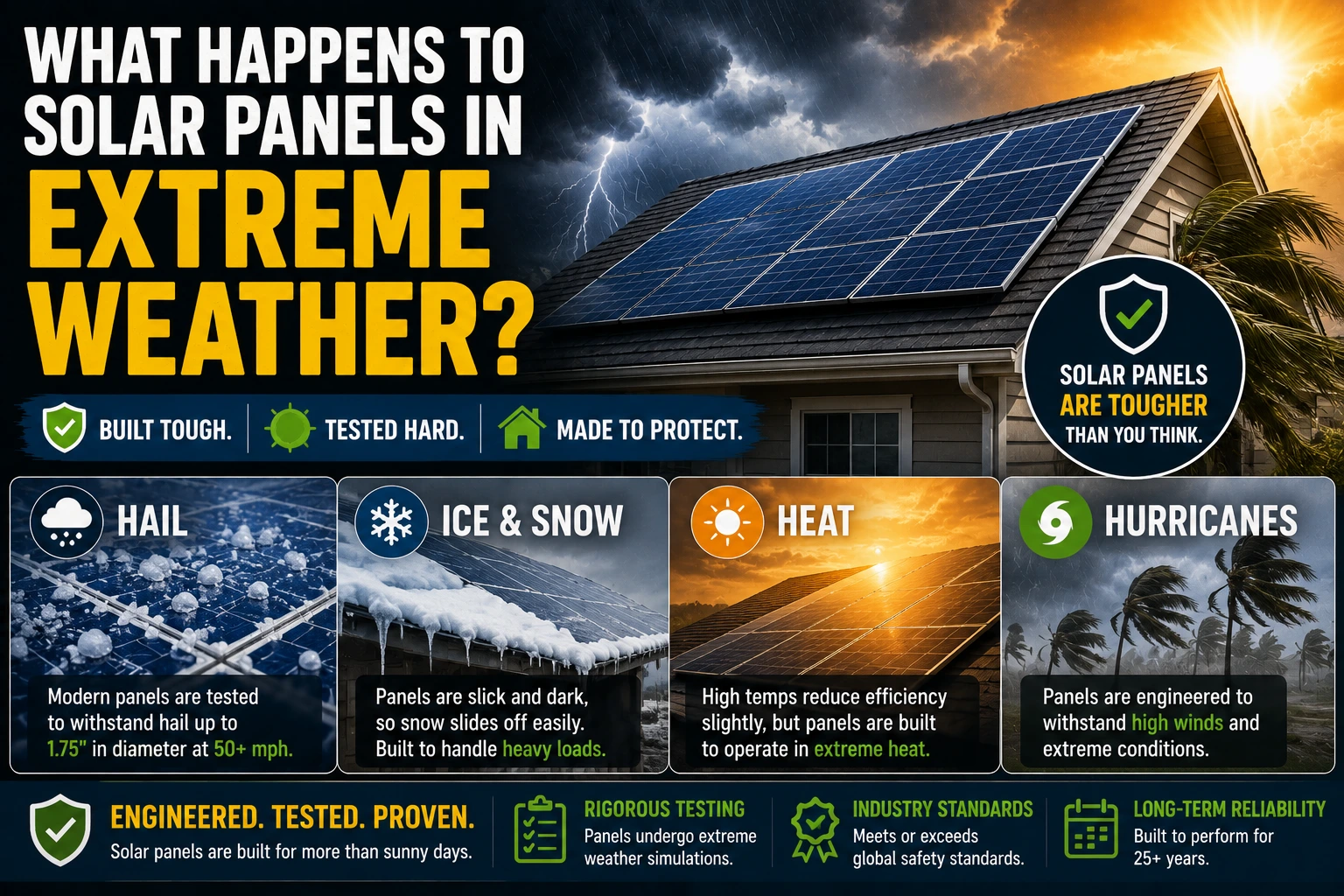
Every solar panel sold in the US must pass IEC 61215 hail testing — 25mm (roughly 1 inch) diameter ice balls at 23 m/s (about 51 mph) impact velocity, hitting the panel at 11 different positions. Passing this test is a baseline requirement, not a premium feature.
Many panels — including SunPower Maxeon — are tested to significantly higher standards. SunPower publishes data showing their Maxeon panels passing hail tests at 2-inch diameter with no structural damage. The Insurance Institute for Business and Home Safety (IBHS) runs independent panel hail testing, and their published results show that most Tier 1 panels from reputable manufacturers hold up well through 1.5–2 inch hail.
The structural reason: a solar panel’s tempered glass front layer is designed to absorb and distribute impact. The glass may develop internal micro-fractures under extreme impact — not visible to the naked eye — but these rarely reduce output measurably unless the impact is severe enough to visibly crack or shatter the surface.
The real hail concern isn’t direct impact — it’s system-level assessment afterward. After any significant hail event, the right move is what I did: check your monitoring app immediately. Look for:
- Any panel showing offline or significantly reduced output
- A panel producing 15–20% less than its immediate neighbors (which might indicate internal micro-cracking affecting one cell string)
Most monitoring apps timestamp production data to 15-minute intervals, so you can compare post-storm output to pre-storm output at the same time of day. A meaningful drop that persists through a clear sunny day after the storm is worth a professional inspection.
The caveat: Baseball-sized or larger hail in a direct, severe storm — the kind that totals cars — can crack panel glass. It’s rare, but it happens. This is exactly why verifying that your homeowner’s insurance covers roof-mounted solar is essential before install, not after. A cracked panel that fails inspection is a warranty and/or insurance claim, not a reason to panic — but only if you’ve confirmed coverage.
Snow and Ice: Cold Is Actually Your Friend (Mostly)
Here’s something that surprises most people: solar panels perform better in cold temperatures than in heat. The efficiency of photovoltaic cells increases as temperature drops. On a clear, cold December day with full sun and snow on the ground reflecting additional light onto the panels, a well-positioned system can outperform a hot July day despite shorter daylight hours.
Snow accumulation on panels: Most residential panels are installed at 15–30 degree angles, and the smooth glass surface sheds snow efficiently once sun returns. A light snowfall typically clears within hours of sunrise. Heavy snow accumulation can temporarily reduce or stop output, but panels are structurally rated for substantial snow loads — typically 5,400 Pa or greater, equivalent to roughly 2–3 feet of dense packed snow. Structural failure from snow load is extremely rare in properly installed systems on code-compliant roofs.
The ice storm problem is a grid problem, not a panel problem. Texas’s February 2021 Winter Storm Uri froze natural gas supply lines, knocked out power plants, and cut grid power to millions of homes. Solar panels kept producing electricity throughout much of the storm — cold, sunny days are actually good solar days. The problem was that standard grid-tied solar systems automatically shut off when the grid goes down (for safety reasons — you can’t have rooftop systems energizing lines that utility workers are trying to repair).
Homes with batteries — like mine, post-March 2023 — can operate in “island mode” during grid outages, using panel production and stored battery power. Homes with grid-tied solar only were in the same situation as non-solar homes during Uri: no power. This is the real operational case for home battery storage that became viscerally clear to a lot of Texas homeowners after 2021.
Extreme Heat: The Efficiency Loss Nobody Talks About Enough
This is the weather vulnerability that gets the least attention in solar marketing, and it’s the most relevant for Sun Belt homeowners.
Solar panels have a temperature coefficient — the rate at which output decreases as panel temperature rises above the standard test condition of 25°C (77°F). When a dark panel surface sits under direct summer sun, the panel itself can reach 60–80°C even on a day when air temperature is “only” 100°F.
Standard monocrystalline panels: Temperature coefficient of approximately -0.40 to -0.45% per degree Celsius above 25°C. A panel at 70°C — common in Phoenix and Austin summers — is operating at 45°C above the test baseline. At -0.42%/°C, that’s a 18.9% reduction from the panel’s rated output.
SunPower Maxeon panels: Temperature coefficient of -0.27%/°C — among the best in the residential market. The same 70°C panel surface produces a 12.2% reduction from rated output. Better, but still meaningful.
This is why production estimates should always be based on real local temperature data, not just sun hours. A Phoenix installer who quotes your annual production using only irradiance without applying a realistic temperature derating is giving you an optimistic number. Ask them explicitly how they’ve accounted for temperature coefficient in their production model.
The practical upside: Most production estimate tools (PVWatts, Enphase’s design software, SolarEdge’s design tools) apply temperature derating automatically. The number they quote you should already reflect Arizona or Texas summer heat losses. If an installer is pulling numbers directly from a panel’s rated output without any temperature adjustment, that’s a yellow flag.
Hurricanes and High Winds: The Mounting System Is the Variable
Solar panels are tested for wind load resistance under UL 61730 and IEC 61730 standards — typically rated to withstand 2,400–5,400 Pa of wind pressure, which corresponds to approximately 90–130 mph sustained wind depending on the pressure calculation method.
Category 1 hurricanes (74–95 mph), Category 2 (96–110 mph), and the lower range of Category 3 (111–129 mph) fall within or close to panel wind load ratings under most test standards. Category 4 and 5 storms (130+ mph) exceed what most residential panel testing covers, and flying debris — not direct wind pressure — is the primary damage mechanism at those wind speeds.
The critical variable is the racking and mounting system, not the panels themselves. Panels properly mounted with hurricane-rated racking on a structurally sound roof have survived Category 3 and some Category 4 events with minimal damage. Panels installed with undersized lag bolts, improper flashing, or on roofs with pre-existing structural weaknesses are a different story.
Florida’s building code evolution after Hurricane Andrew in 1992 significantly tightened roofing standards statewide — which means a post-2000 Florida home typically has a more hurricane-ready roof deck than homes in states without that regulatory history. But the solar mounting must be hurricane-rated specifically; not all installers in coastal markets use the same hardware specifications. This is one of the specific questions Florida homeowners should put to every installer before signing a contract.
Post-hurricane visual inspection checklist:
- Racking rails — any visible movement, tilting, or separation from the roof?
- Panel surfaces — visible cracks, broken glass, delamination?
- Conduit and wiring — any sections pulled loose, exposed wiring?
- Monitoring — any panels offline or producing anomalously after the storm passes?
A system that survives a major storm with no visible damage and normal monitoring data almost certainly came through intact. One that shows any of the above warrants a professional inspection before the next operation cycle.
The Weather-Proof Checklist Before You Install
If you’re buying solar in a weather-challenged region, here are the specific questions to ask before signing:
For hail-prone areas (Texas, Colorado, Midwest): What is the hail rating of the panels being quoted? Has the manufacturer published impact test data beyond the IEC baseline? Is roof-mounted solar explicitly covered under my homeowner’s policy?
For snow-heavy areas (Mountain West, New England, Midwest): What is the roof snow load rating? What is the panel’s rated mechanical load? How does the installation angle account for snow shedding?
For extreme heat markets (Arizona, Nevada, inland California, Texas): What temperature coefficient does the quoted panel carry? How has the installer applied temperature derating in the production estimate?
For hurricane and high-wind coastal markets (Gulf Coast, Atlantic Coast, Hawaii): What is the wind uplift rating of the specific racking system being used? Are the lag bolt spacing and penetration depth compliant with local wind zone requirements? Has the installer done installs that survived previous named storms in this area?
For all markets: Does your homeowner’s insurance policy cover roof-mounted solar for both weather damage and the additional liability of the installation? Get that answer in writing before the contract is signed, not after.
I covered the Texas-specific weather and grid resilience picture in my full Texas solar guide, including the February 2021 context and why battery backup changed the calculation for a lot of Austin homeowners including me.
The bottom line on extreme weather: modern, properly installed solar panels from reputable manufacturers are more weather-resilient than most homeowners expect. The vulnerabilities are real — extreme hail, Category 4+ hurricane debris, and heat-driven efficiency loss are genuine factors — but they’re manageable with the right hardware selection, installation quality, insurance coverage, and monitoring habits. The panels on my roof have been through two Texas summers, one significant hail event, and a winter ice storm, and they’re performing within 1% of original projections.
That’s a good track record. The engineering behind it is solid.
— Allen
