

Denver sits at 5,280 feet above sea level. That number — the “Mile High City” — turns out to be directly relevant to solar panel performance in a way that most solar discussions don’t mention.
At higher elevations, the atmosphere is thinner. Less air means less atmospheric scattering and absorption of sunlight before it reaches the panels. The effect: solar panels in Denver produce measurably more electricity per rated watt than the same panels would produce at sea level in comparable weather — roughly 10–15% more than irradiance maps alone predict. A solar resource map showing Denver at 5.0 peak sun hours understates actual panel output compared to a coastal city at the same irradiance rating.
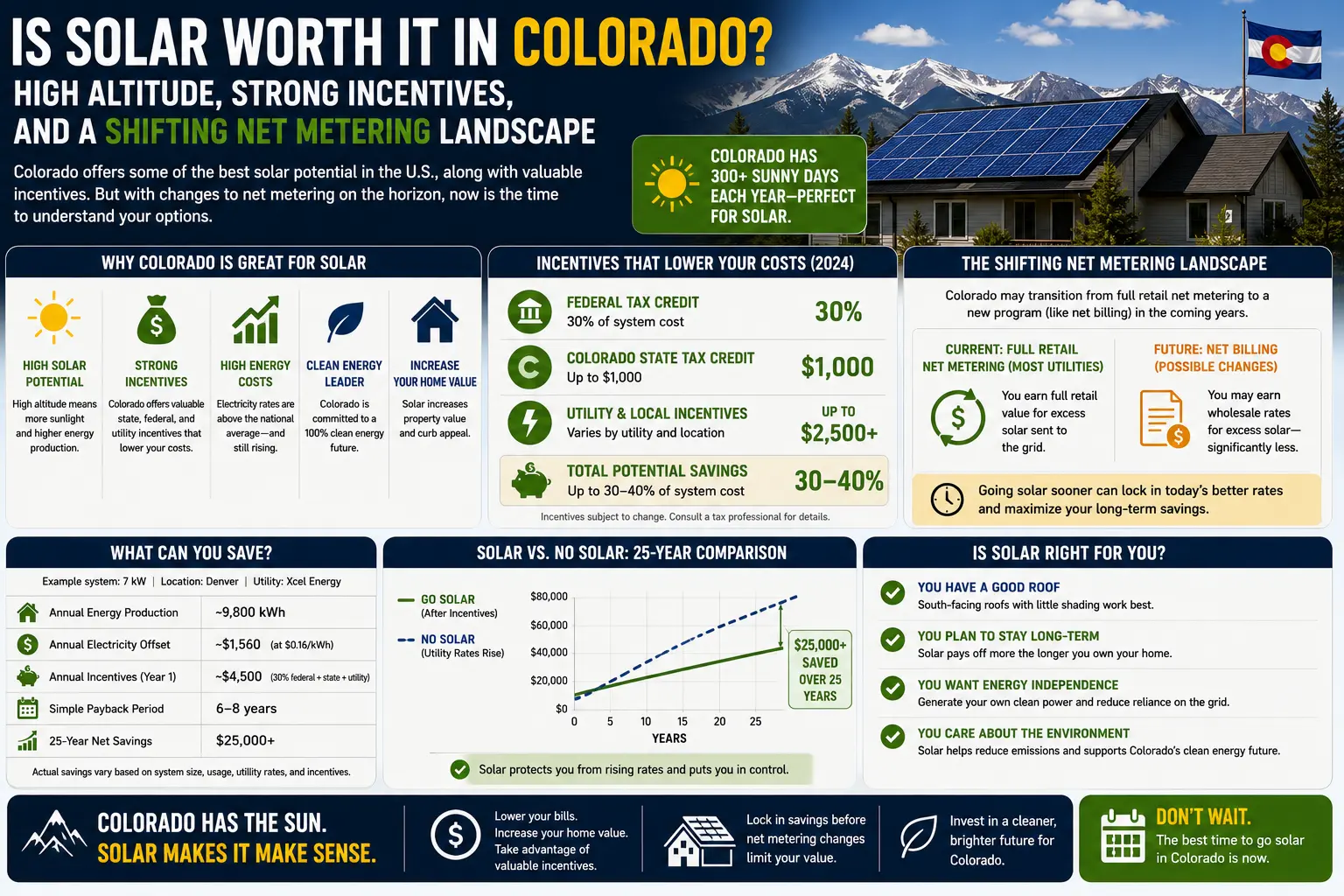
This altitude bonus, combined with Colorado’s 300+ days of annual sunshine, strong state-level property and sales tax exemptions, and Xcel Energy’s full retail net metering policy, makes Colorado a genuinely attractive solar market — with one specific caveat that matters a lot depending on where you live.
The Colorado Solar Resource
Colorado consistently ranks among the top 10 US states for solar resource. Denver averages 5.0–5.1 peak sun hours per day at the surface — comparable to Austin, Texas. The altitude effect means effective panel output is closer to what you’d see in a 5.5 peak sun hour environment at sea level.
The Front Range corridor — Denver, Boulder, Fort Collins, Colorado Springs — has excellent solar conditions year-round. Mountain towns at higher elevations get even more solar resource but face more challenging installation environments (steep roofs, snow loads, more extreme temperature swings).
Colorado’s solar challenge is not sun — it’s weather variance. The Front Range sits in North America’s “hail alley” — the region with the highest frequency of significant hail events in the country. As I covered in my extreme weather post, modern quality panels handle hail well, but Colorado homeowners should verify panel hail ratings and confirm insurance coverage before installation more carefully than homeowners in most other states.
Snow is a lesser concern than most people assume. Colorado’s Front Range sun melts roof snow quickly, and panels shed snow efficiently once sun hits them. A snowy December day is followed by a clear, cold, high-production day where the white ground below actually reflects additional light onto the panels.
Colorado’s Incentive Stack
Federal Investment Tax Credit (30%): Same as every state — the 30% ITC on gross system cost is the starting point.
State sales tax exemption: Colorado exempts solar energy equipment from the state’s 2.9% sales tax. Many Colorado counties and municipalities layer their own sales tax exemptions on top. Denver’s combined sales tax is 8.81% — and solar equipment is exempt from all of it for Denver residents. On a $28,000 system, that’s up to $2,467 in immediate tax savings at Denver’s combined rate.
Property tax exemption: Colorado’s residential solar property tax exemption is one of the strongest in the country — solar installations are completely exempt from property tax assessment. No cap, no time limit. The full market value premium that solar adds to your home (typically $15,000–$25,000 based on national averages) generates $0 in additional property tax. In a high-property-tax county like Boulder or Jefferson, this is a meaningful annual benefit.
HOA protection: Colorado passed legislation in 2008 (C.R.S. 38-30-168) restricting HOA authority to prohibit or unreasonably restrict solar installations. If your HOA is pushing back on solar, Colorado law is on your side — HOAs can regulate aesthetics and placement to a degree but cannot prohibit rooftop solar outright.
Xcel Energy Solar*Rewards: Xcel Energy — the dominant utility serving the Denver metro, Boulder, Fort Collins, and Colorado Springs — has historically offered a production incentive for solar customers through the Solar*Rewards program. This program has evolved significantly and incentive levels have declined as Colorado’s solar capacity has grown. Check directly with Xcel for current program availability and rates; the program may be fully subscribed or restructured by the time you read this.
Net Metering in Colorado: The Key Variable
Net metering policy in Colorado depends entirely on which utility serves your address — and the difference between territories is significant.
Xcel Energy: Colorado’s largest utility maintains full retail net metering for residential solar customers with systems up to 120% of their prior-year consumption. Monthly excess production credits roll forward through the annual billing cycle; at the annual true-up, any remaining excess credits are compensated at Xcel’s avoided cost rate (lower than retail). For most homeowners sizing their system appropriately, this annual rollover structure works well — summer surplus offsets winter deficit, and the annual true-up handles any remaining balance.
The Xcel net metering policy has faced pressure in recent regulatory proceedings, and the company has proposed modifications. The same utility-driven push against full retail net metering that reshaped California and Arizona is an ongoing political dynamic in Colorado. Current policy is favorable; the direction of travel warrants attention for anyone making long-term payback projections.
Rural electric cooperatives (RECs) and municipal utilities: Colorado has dozens of smaller electric utilities serving rural areas and smaller cities. Their net metering policies vary widely — from full retail compensation to minimal export rates. If you’re outside Xcel or Black Hills Energy territory, researching your specific cooperative’s solar interconnection policy is essential before sizing a system.
Black Hills Energy (southeastern Colorado, Pueblo area): Has maintained a net metering program but with some restrictions on system size and export compensation that differ from Xcel. Check current tariffs through the Colorado PUC filings if you’re in Black Hills territory.
The Numbers: Colorado Payback Estimate
For a Denver homeowner on Xcel Energy with average electricity consumption:
- System: 9.6kW
- Annual production (altitude-adjusted): ~14,800 kWh
- Electricity rate: $0.134/kWh (Xcel residential blended rate)
- Annual electricity savings: ~$1,983 (self-consumption at full retail)
- Net metering export credits: ~$400 (surplus production at retail during shoulder months)
- Total annual benefit: ~$2,383
- System gross cost: $28,000
- Sales tax savings (~8.8%): $2,464
- Net after sales tax exemption: $25,536
- Net after 30% ITC: $17,875
- Estimated payback: approximately 7.5 years
That payback tightens for homes with higher consumption (air conditioning in Denver summers, electric heat, EVs) and loosens for smaller systems or homes with significant shading. The mountain community solar market — Aspen, Vail, Steamboat Springs — involves additional complexity around local utility policies, tree shading, and extreme weather that makes site-specific analysis more important than the Front Range average.
Community Solar in Colorado
Colorado has one of the more developed community solar markets in the country. Xcel Energy operates a community solar program that allows customers — including renters — to subscribe to shares of community solar farms and receive credits on their utility bills. If you’re a Colorado renter, own a shaded property, or have a roof that doesn’t work for installation, Colorado’s community solar option is worth exploring as an alternative.
Who Should Go Solar in Colorado Right Now
Strong candidates:
- Front Range homeowners on Xcel Energy with unshaded south or southwest facing roof sections
- High-consumption households (electric heat, EV, large homes) — the same high-usage advantage that applies nationally is especially relevant in Colorado’s cold winters with electric heating
- Homeowners in high-property-tax counties where the property tax exemption has significant annual value
Verify carefully before proceeding:
- Rural co-op customers — your net metering policy may be significantly less favorable than Xcel’s
- Mountain properties with significant shading, complex rooflines, or extreme snow loads
- Homeowners considering system sizes more than 120% of annual consumption (excess beyond that threshold isn’t compensated at retail under Xcel’s policy)
Colorado is a genuine solar opportunity — altitude, sun, and policy all support it on the Front Range. The hail reality is real but manageable with quality panels and proper insurance. The net metering policy is currently favorable and worth acting on before regulatory proceedings change it.
— Allen
