

In 2047, my SunPower panels will be 25 years old.
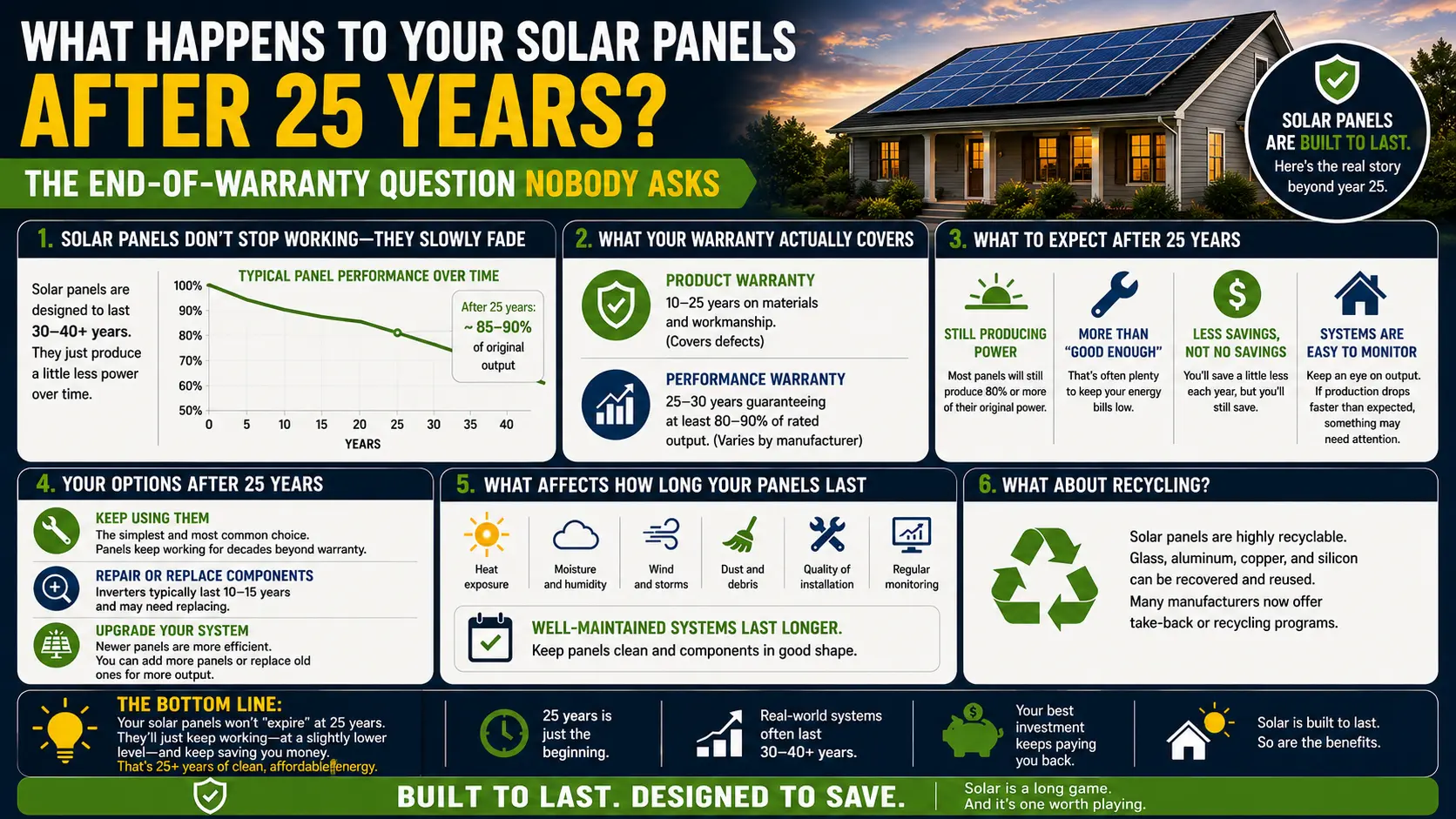
I’ll be 63. Claire will remind me I forgot to ask this question when we were shopping installers in 2022. And based on everything I’ve researched, here’s what I expect to happen: the panels will still be generating electricity. Probably at 94% or more of their original output. Nothing dramatic will occur. The warranty will have expired. The panels will keep working.
The 25-year solar warranty is the most cited specification in residential solar, and it’s also the least understood. Most people hear “25-year warranty” and mentally translate it to “25-year lifespan.” These are not the same thing — and the distinction matters for how you think about the long-term economics of a system you’re buying today.
What the 25-Year Warranty Actually Guarantees
I covered the warranty structure in detail in my longevity post, but the relevant piece here: SunPower’s Maxeon warranty guarantees that at year 25, the panels will be producing no less than 92% of their original rated output. The guaranteed degradation rate is a maximum of 0.25% per year. At that rate, year-25 production is 94.25% of original.
Standard monocrystalline panels from other reputable manufacturers guarantee 80–87% of original output at year 25, using a maximum degradation rate of 0.45–0.7% per year.
What happens at year 25: the warranty coverage period ends. The manufacturer’s obligation to replace or compensate you for underperforming panels expires. The panels themselves don’t receive a signal to stop working.
How Long Do Solar Panels Actually Last?
NREL (the National Renewable Energy Laboratory) maintains a database of real-world panel performance and longevity data going back decades. Their research on panel lifetimes consistently shows median useful life well beyond 25 years:
- Panels from the 1980s and early 1990s installed on test sites are still generating electricity today — 35 to 40+ years later, at reduced but meaningful output
- The most common cause of panel failure is not degradation but physical damage — cracked glass, water intrusion from damaged seals, or rodent damage to wiring
- Statistical failure rates for quality panels are low: roughly 5% of panels show significant performance issues within the first 10 years, and that includes installation-related issues
NREL’s analysis of long-term degradation rates found that the median panel degrades at approximately 0.5% per year — meaning a panel rated 400W at year 0 is still producing about 375W at year 25, and about 350W at year 35. Not full output, but far from dead.
For SunPower Maxeon panels with the industry-leading 0.25% degradation guarantee, year 35 production is approximately 91.25% of original — which would be 365W on a 400W-rated panel. By any reasonable definition, that panel is still worth keeping on the roof.
What Actually Needs Replacing Before the Panels Do
If you install solar today and own it for 30+ years, here’s the honest maintenance timeline for each component:
Panels: Expect 30–35+ years of productive operation from quality tier-1 panels. No scheduled replacement. Monitor output; replace if a panel fails (which the warranty covers for the first 25 years, and out-of-warranty replacement costs for individual panels will likely be $150–300 per panel by the late 2030s given ongoing cost decline trends).
Microinverters (Enphase IQ8 series): 25-year warranty, matching the panels. Replace individually if one fails. No whole-system inverter replacement expected within the warranty period.
String inverters: 10–12 year warranty. Expect one replacement within a 25–30 year system lifetime. Budget $2,000–3,500 installed for a mid-life inverter replacement, or $1,500–2,500 for just the equipment if you can find a local installer. This is one of the real long-term cost arguments for microinverters over string inverters — a single failed component rather than a full inverter replacement.
Racking and mounting hardware: Quality aluminum racking has a useful life of 30+ years in most climates. The roof penetration sealants — the flashing and butyl tape around each roof mount — may need inspection and potential resealing at the 20–25 year mark. This is a relatively minor maintenance item, not a full racking replacement.
Wiring and conduit: Outdoor-rated electrical wiring has a useful life of 25–30 years under normal conditions. Extreme UV exposure (Arizona, desert Southwest) may accelerate degradation of conduit and wire jacket materials. Worth including in a 20-year inspection.
Monitoring equipment: Enphase gateways and communication hardware have shorter functional lifetimes — 7–10 years typically before they’re outdated by software and hardware evolution. Monitoring hardware is inexpensive to replace ($150–300) and doesn’t affect system output, just visibility. Expect 2–3 monitoring hardware generations over a 30-year system life.
The Financial Picture at Year 25
Here’s the calculation I ran for my own system to understand what year 25 actually looks like financially.
My system net cost (after 30% ITC): $19,747. Annual electricity savings, conservatively: $3,230/year. Simple payback: 6.1 years.
By year 25, the cumulative savings exceed $80,000 at current electricity rates — and electricity rates historically increase roughly 2–3% per year, which means the later years of the system produce more savings per year than the early years. The system has paid for itself approximately four times over by year 25.
What is the year-26 marginal value of keeping the panels running? Every year of continued operation at 94% original output generates approximately $3,040 in electricity savings at current rates — with zero remaining capital cost to recover. The panels don’t know the warranty expired. They just keep converting photons to electrons.
The decision at year 25 is not “do I replace the system?” It’s “should I upgrade?” And the upgrade calculus will depend on panel prices and technology in 2047, which I cannot predict precisely — but if trends continue, a newer system will be cheaper, more efficient, and available with a fresh warranty. The old panels can be removed and recycled.
Panel Recycling and End-of-Life
Solar panels are not toxic waste, and the narrative that they’ll create an environmental crisis at end-of-life is significantly overstated. A typical residential panel is approximately 76% glass, 10% aluminum frame, 8% plastic encapsulant, 5% silicon, and trace amounts of silver and other metals.
The glass and aluminum are readily recyclable. The silicon is low-hazard semiconductor material. Some panels contain small amounts of lead (in older solder) or cadmium (in certain thin-film panels) — conventional crystalline silicon panels like mine use neither. SunPower Maxeon cells use copper backing, which is fully recyclable.
Panel recycling infrastructure is growing. First Solar has operated a panel recycling program for their products for years. The Solar Energy Industries Association has published a National PV Recycling Program framework. European regulations (WEEE Directive) have mandated panel recycling since 2014, establishing the logistics infrastructure that the US market is increasingly adopting.
By 2047, when my panels approach end-of-life, I expect residential panel recycling to be routine — similar to how appliance and electronics recycling infrastructure developed over the past 30 years. The economics of recovering silver and silicon from panels improve as panel volumes increase.
The Practical Planning Advice
If you’re buying solar today, here’s how to think about the post-warranty question:
Don’t size your financial case around year-25 replacement costs. The panels will likely outlast the warranty period, meaning your payback period calculations are if anything conservative — you’re likely getting years of production you haven’t counted.
Do budget for one inverter replacement if you have a string inverter. Set aside $2,500–3,500 for a mid-life string inverter replacement around year 10–12. With microinverters, this budget item disappears.
Plan a comprehensive inspection at year 20. Before the warranty window closes completely, have the system professionally inspected. Any panel showing significant degradation beyond the warranty guarantee rate should be flagged for a warranty claim while the guarantee is still active.
Think about the roof timing. If your roof will need replacement sometime in the next 25 years — and most will — plan for a panel removal and reinstallation. The cost of removal and reinstallation by an installer runs $1,500–3,000 for a typical residential system. Factor this into your long-term cost model if a roof replacement is likely in the 10–15 year window.
In 2047, I expect to be deciding whether to keep my original SunPower panels running or upgrade to whatever the 2047 equivalent of today’s technology is. Based on the home value research, a system entering its final warranty years adds less value at sale than a newer system — so if we’re thinking about selling the house, an upgrade in the early 2040s might make financial sense. If we’re staying, let them run.
Either way, the system will have produced its value many times over before we face that decision.
— Allen
