
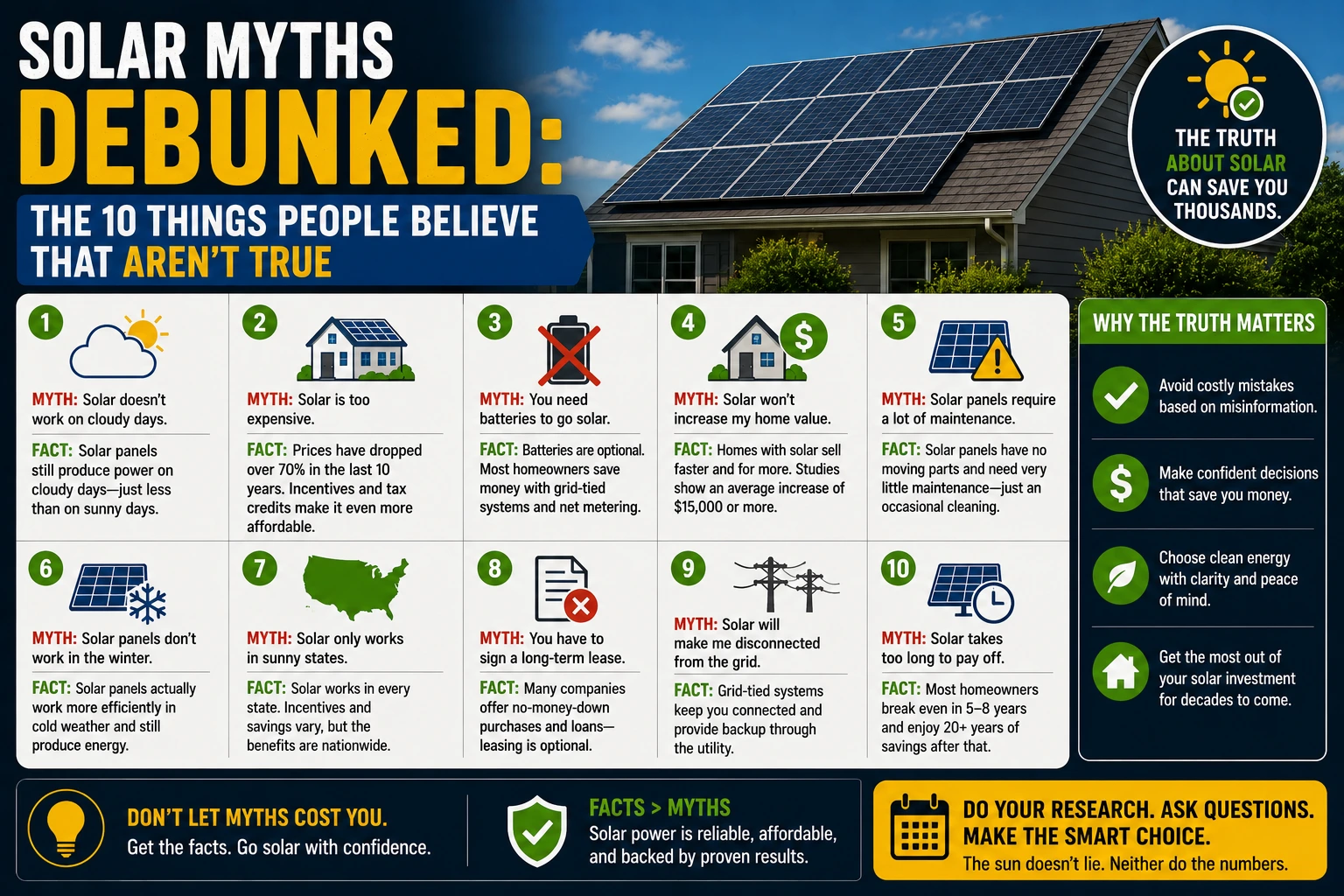

Last Fourth of July, Dave’s brother-in-law cornered me at the cookout. He’d heard I had solar and had questions — which turned out to be mostly confident assertions that I gently had to correct over the course of forty minutes. By the time burgers were ready, I’d debunked the same myths I see circulating constantly online, in comment sections, and apparently at family gatherings across America.
Some of these myths keep people from a decision that would genuinely benefit them. Others give people unrealistic expectations that lead to disappointment. A few are just outdated information from a decade ago that never got corrected. Here are the ten I encounter most often, and what’s actually true.
Myth 1: “Solar Doesn’t Work in Cloudy or Cold Climates”
Germany generates more solar power per capita than almost any country on earth. It gets roughly 1,600–1,700 peak sun hours annually — less than Austin’s 2,150, less than most of the US Sun Belt, and roughly equivalent to Seattle. Germany’s solar industry isn’t a fluke: solar panels generate electricity from daylight, not direct sunshine. They produce less on cloudy days, but they produce.
Cold temperatures actually improve panel efficiency. PV cells convert light to electricity more efficiently at lower temperatures — the temperature coefficient I covered in my extreme weather post means panels lose efficiency in Phoenix summers that they retain in Massachusetts winters.
The states with the most economically favorable solar conditions aren’t necessarily the sunniest — they’re the ones that combine adequate sun hours with high electricity rates. Massachusetts, New York, and New Jersey have below-average sun but above-average solar economics because their electricity is expensive and their state incentives are strong.
Myth 2: “Solar Is Too Expensive”
The installed cost of residential solar has fallen approximately 90% since 2010. A watt of installed solar that cost $7–8 in 2010 costs $2.50–3.50 today. The 30% federal tax credit reduces the net cost further. When I ran the full cost breakdown for my system, the net-of-ITC cost was $19,747 for a premium 9.6kW system — one that will return its cost in electricity savings within six years and then generate essentially free electricity for another two decades.
“Too expensive” relative to what? Relative to doing nothing and continuing to pay $3,700+ per year in electricity bills for the next 25 years? The analysis doesn’t support that conclusion for most homeowners with adequate sun and ownership of their roof.
Myth 3: “Solar Will Damage My Roof”
A properly installed solar system doesn’t damage your roof — in many cases, the roof area under the panels is better protected than the exposed areas around them because it’s shielded from UV exposure, hail, and temperature cycling that degrade roofing materials over time.
The real risk comes from improper installation: inadequate flashing at penetration points, undersized lag bolts, or installers who skip the waterproofing steps. This is a contractor quality issue, not a solar technology issue. The right installer drills carefully, uses the right sealants and flashing hardware, and pulls the permits that require a structural and electrical inspection.
If your roof is near end-of-life, do the replacement first, before solar installation — not after. Installing solar on a roof that needs replacement in 3 years means paying for a panel removal and reinstallation when the new roof goes on. Most installers will tell you this; the ones who push you to proceed on an aging roof are not acting in your interest.
Myth 4: “My Roof Has to Face South”
South-facing is optimal — a south-facing roof at 20–35 degrees of tilt captures the most annual solar energy in the northern hemisphere. But east- and west-facing roofs are not disqualifying. East-west oriented systems produce 10–20% less annually than an equivalent south-facing system, but that tradeoff changes the economics rather than eliminating them.
East-west configurations also have a practical advantage: they spread production across more of the day, capturing morning sun (east) and afternoon sun (west) rather than concentrating production in a midday peak. This slightly better matches typical household consumption patterns and can improve self-consumption ratios.
Mixed-orientation roofs — part south, part east, part west — work fine with microinverters, which optimize each panel independently. String inverters are less suited to mixed orientations. If your roof has multiple faces, make sure the inverter discussion happens before equipment is specified.
Myth 5: “Solar Pays for Itself in One or Two Years”
This one frustrates me because it comes from somewhere — aggressive installer marketing that conflates “the monthly savings exceed the monthly loan payment” with “the system has paid for itself.” These are not the same thing.
Real payback periods for owned residential solar systems in the US range from 5 to 12 years depending on system cost, electricity rate, sun hours, available incentives, and how the system is sized to actual consumption. My own payback period, with a premium SunPower system and Austin Energy’s rates, is approximately 6 years on the net-of-ITC cost. That’s genuinely good — but it’s not one or two years.
If an installer or ad tells you payback is 18 months, ask them to show their math. It almost certainly conflates gross production value (every kWh at retail rate) with actual bill reduction, ignores the principal repayment if financed, or applies a system cost that’s been reduced by credits the installer has already factored into their business model.
Myth 6: “You Need to Go Off-Grid for Solar to Be Worth It”
The vast majority of residential solar in the US is grid-tied — connected to the utility grid, exporting excess power, and drawing from the grid when panels aren’t producing. This is not a compromise. It’s the economically optimal configuration for most homeowners.
Off-grid solar requires enough battery capacity to cover days or weeks of no-sun production, which means dramatically more storage than a grid-tied-plus-battery system needs. The cost of that storage makes off-grid systems 2–3x more expensive for equivalent reliability. For homeowners in utility service territory with access to grid power, off-grid is almost never the right financial choice — it’s a lifestyle and independence choice for those who specifically value it.
Grid-tied systems with a single battery give you backup capability during outages while avoiding the enormous storage overhead of true off-grid design. That’s the configuration most homeowners actually need.
Myth 7: “Solar Panels Require a Lot of Maintenance”
I’ve covered this in detail in my maintenance post after two years of ownership. The short version: in two years, I’ve cleaned my panels once and spent approximately two hours total on monitoring. Total out-of-pocket maintenance cost: $0.
Modern panels are designed to be self-maintaining in rainfall-adequate climates. The monitoring app does the inspection work. The warranty covers the one hardware issue I had. Solar is one of the few home improvements that genuinely requires less attention over time, not more.
Myth 8: “Solar Makes Your House Harder to Sell”
The opposite is documented. Research consistently shows owned solar systems add 3–4% to home sale price and improve days-on-market. The full breakdown of the home value research covers the caveats — appraiser competence, system age, owned vs. leased — but the headline finding is consistent: owned solar adds value.
Leased solar is a different story. A lease that transfers to the buyer with complicated assumption paperwork can create friction. This is one of many reasons why ownership is typically preferable to leasing — not just for the economics, but for the eventual home sale.
Myth 9: “You Need a Battery for Solar to Work”
A standard grid-tied solar system operates without any battery storage. The grid acts as a virtual battery — you export surplus during the day, import at night, and the utility nets the two. Batteries add backup capability, TOU arbitrage value, and self-consumption optimization, but they’re not required for the basic system to function or pay off financially.
Whether to add a battery is a separate financial analysis from whether to go solar. For many homeowners — particularly those in utilities with strong net metering and low risk of extended outages — solar without storage pencils out well on its own. The battery decision depends on backup needs, TOU rate structure, and budget.
Myth 10: “You Should Wait — Solar Technology Is About to Get Much Better”
This one has been circulating since at least 2012, and the people who believed it in 2012 have now paid electricity bills for 13 years while waiting for a technology breakthrough that makes today’s panels obsolete.
Residential solar technology improves gradually, not in dramatic leaps. Today’s mainstream monocrystalline panels are at 20–23% efficiency — up from 15–18% a decade ago, but not approaching a discontinuous improvement. The economics of solar have improved dramatically over the past decade, primarily through manufacturing scale reducing costs, not through efficiency jumps.
The more relevant trajectory: panel costs have largely bottomed out at current efficiency levels. The next meaningful improvement in residential solar economics is more likely to come from better battery chemistry (making storage cheaper) than from panel efficiency gains. Waiting for dramatically better panels is not a well-founded strategy.
The households that installed in 2018, 2020, 2022 — they’ve been collecting savings for years. The people still waiting for better technology in 2025 are not closer to a breakthrough. They’re just 5–7 years behind on savings.
— Allen
